Furniture 3D Configurators: What the Best-Scored Have in Common
Selling a modular sofa or a made-to-measure shelf online gets hard the moment shoppers can change its size. Every extra option adds a sales email, and every misjudged dimension risks a return. NRF and Happy Returns expected US online returns to reach 19.3% of online sales in 2025 (NRF, 2025).
A browser 3D configurator is the usual answer, but most "best of" lists for them come from the vendors selling them. This benchmark uses the furniture configurators we score independently to answer one question: what do the best-scored ones do that the rest don't?
The answer is a short checklist you can run against your own configurator, or a vendor's demo, in about 10 minutes. ORGATEC opens in Cologne today, so there's a section on office and workspace configurators too.
The short answer
The best-scored furniture 3D configurators all cover the basics: modular building, material switching and a live price. What sets the leaders apart is letting shoppers save and share a design, and drawing real dimensions on the model. Phones are where even leaders slip: mobile is the weakest furniture sub-score in Interact Gallery's October 2026 data, averaging 3.67 out of 5.
Key takeaways
- Table stakes: modular assembly, material switching and live pricing.
- Clearest separator: saved designs, offered by 9 of the 10 furniture configurators scoring above 4 overall.
- 23 of the 24 we track render real-time 3D, not pre-rendered frames.
- Phones lag, even among the leaders.
- The 10-minute checklist at the end works on your own configurator.
How did we score these furniture configurators?
We score 24 live furniture and workspace configurators, part of 135 live browser 3D apps we track. Each gets 10 editorial sub-scores on a 1 to 5 scale: five for performance, five for UX. Catalog numbers on this page update as listings change; we last checked them on 22 October 2026.
Performance covers stability, initial load feel, responsiveness, asset strategy, and feedback and constraints. UX covers mobile, interactivity, clarity, findability and decision aids. The full rubric, including what earns a 5, is in how we score interactive 3D apps.
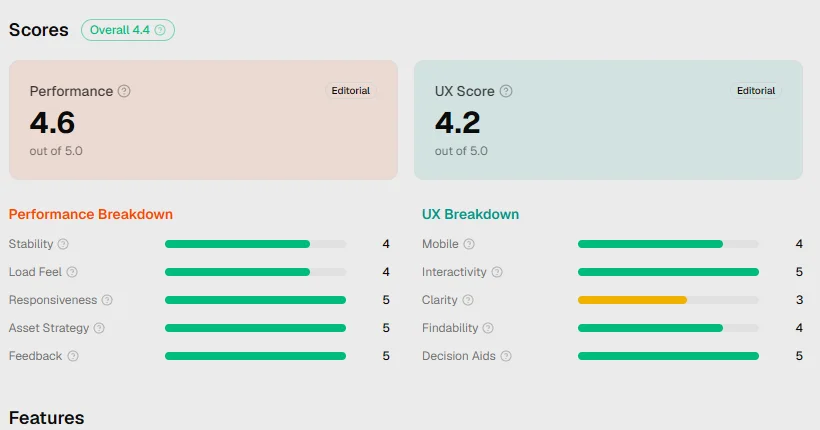
Rankings here use the editorial score, the average of performance and UX. Listing pages also fold in user reviews, so the number on a listing page can differ slightly. Every listing is tested in a desktop browser and on a real phone.
The scores describe what a shopper can see and do in the browser. They don't measure conversion rates, backend integrations or how complex the pricing rules are behind the scenes.
Most "best furniture configurator" lists that rank in search come from vendors. When we searched "best furniture 3d configurator examples" in October 2026, 8 of the top 9 results were published by configurator vendors.
VividWorks' furniture list features 6 of 10 examples from its own clients (VividWorks, checked October 2026). Emersya's top 10 includes 6 built on Emersya (Emersya, updated October 2026).
Those lists show what one vendor can build. They aren't built to compare vendors, or to check how a configurator behaves on a phone.
What do the best-scored furniture 3D configurators have in common?
They share a base of modular building, material switching and live pricing that most of the category already has. Of the furniture configurators we track, 88% support modular assembly, 96% switch materials and 75% calculate the price as you build. The leaders add saved designs and on-model dimensions, which the middle of the pack often skips.
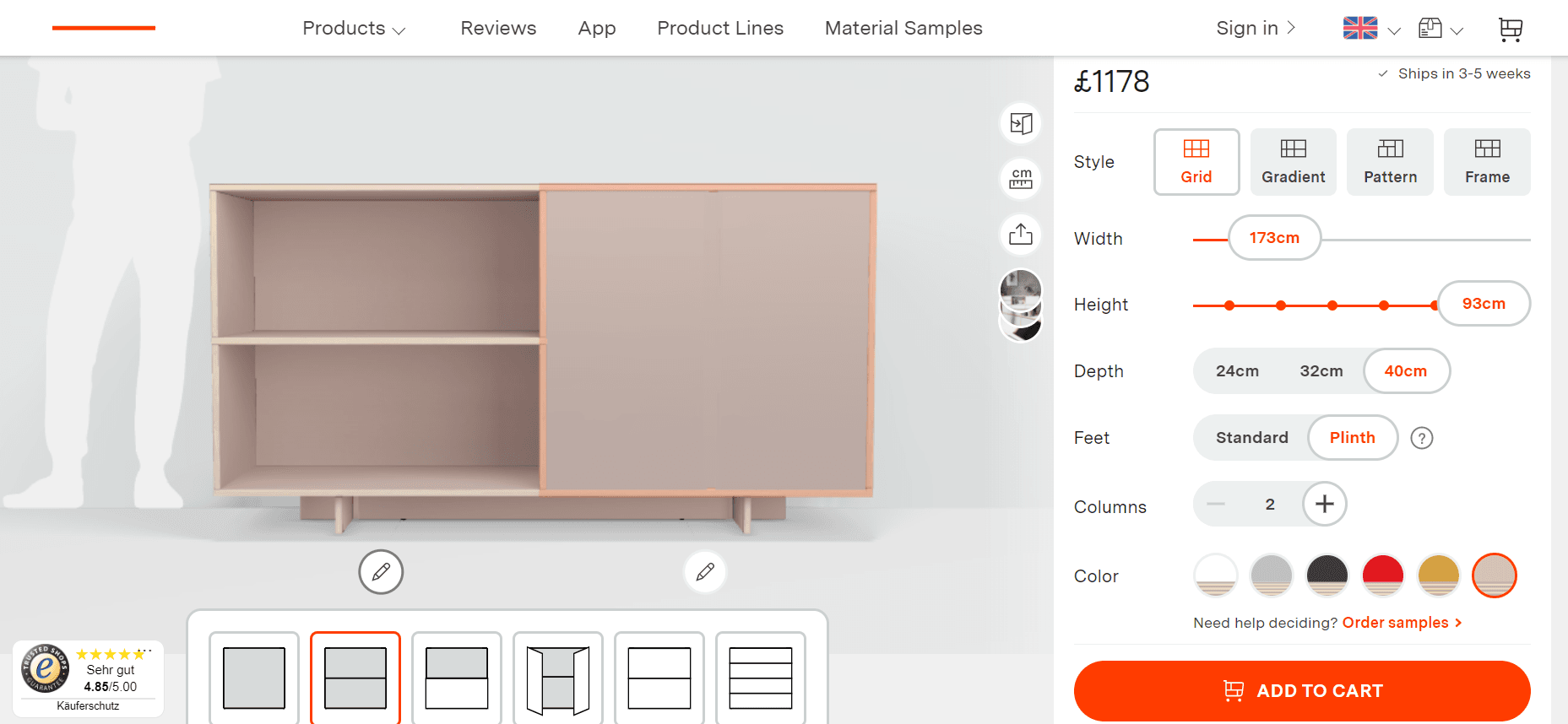
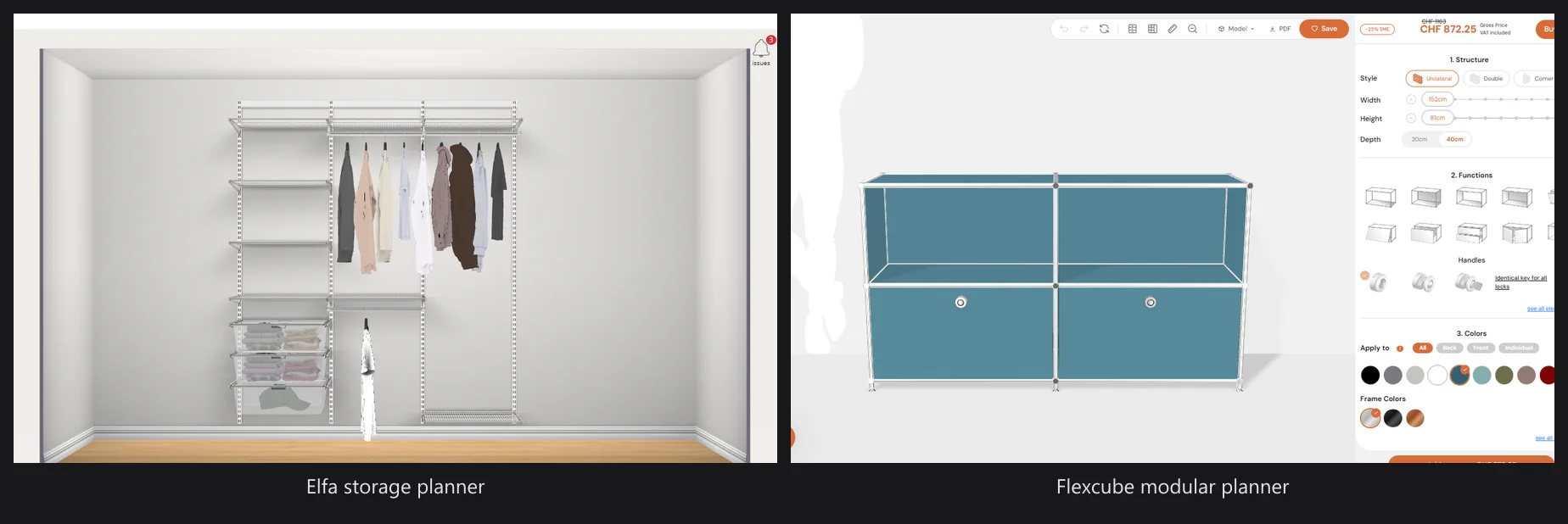
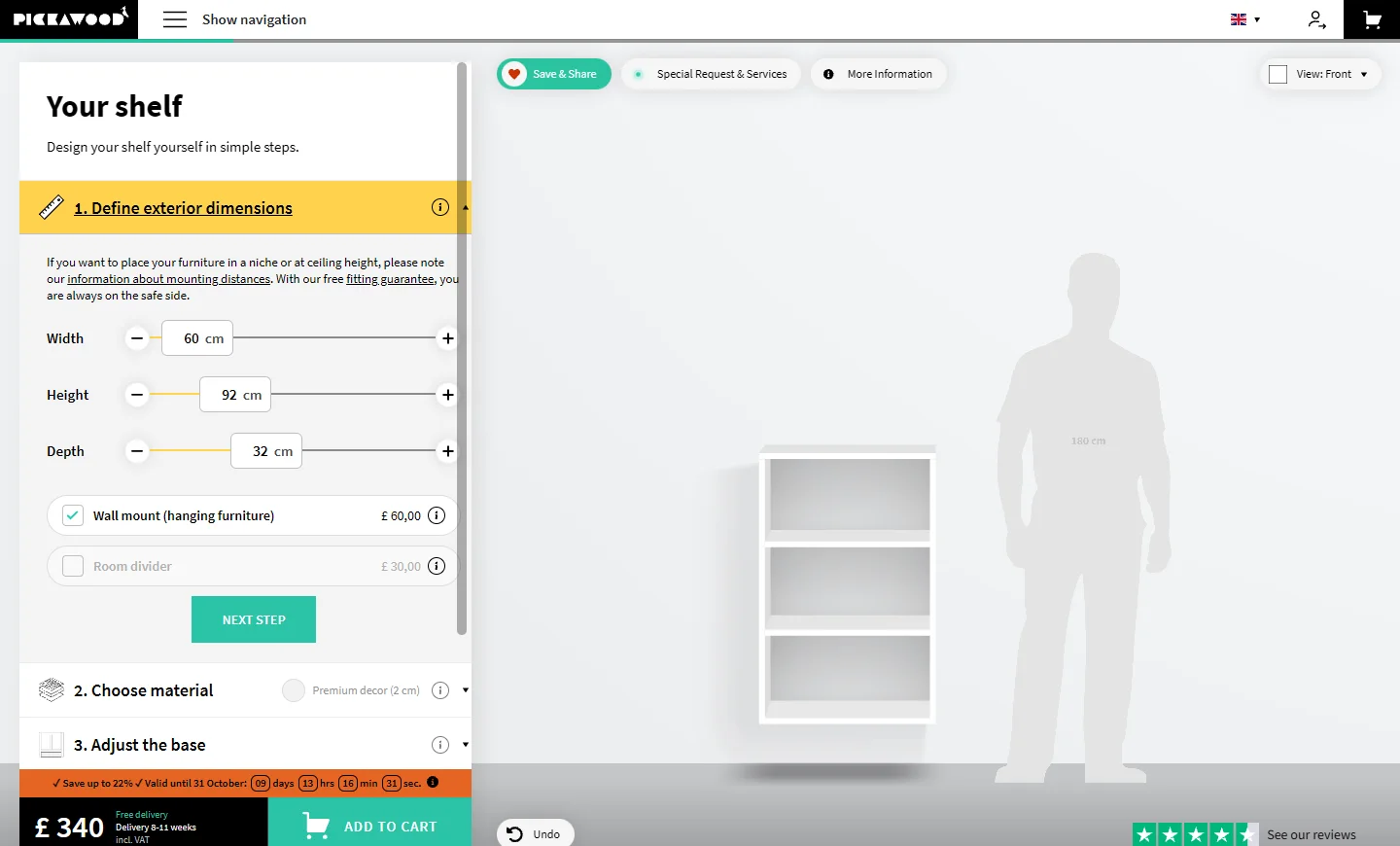
At the time of writing, the four highest-scored are Elfa's storage planner, IKEA's planning tools, Tylko and Pickawood. All four sell storage or shelving, where the size is the product.
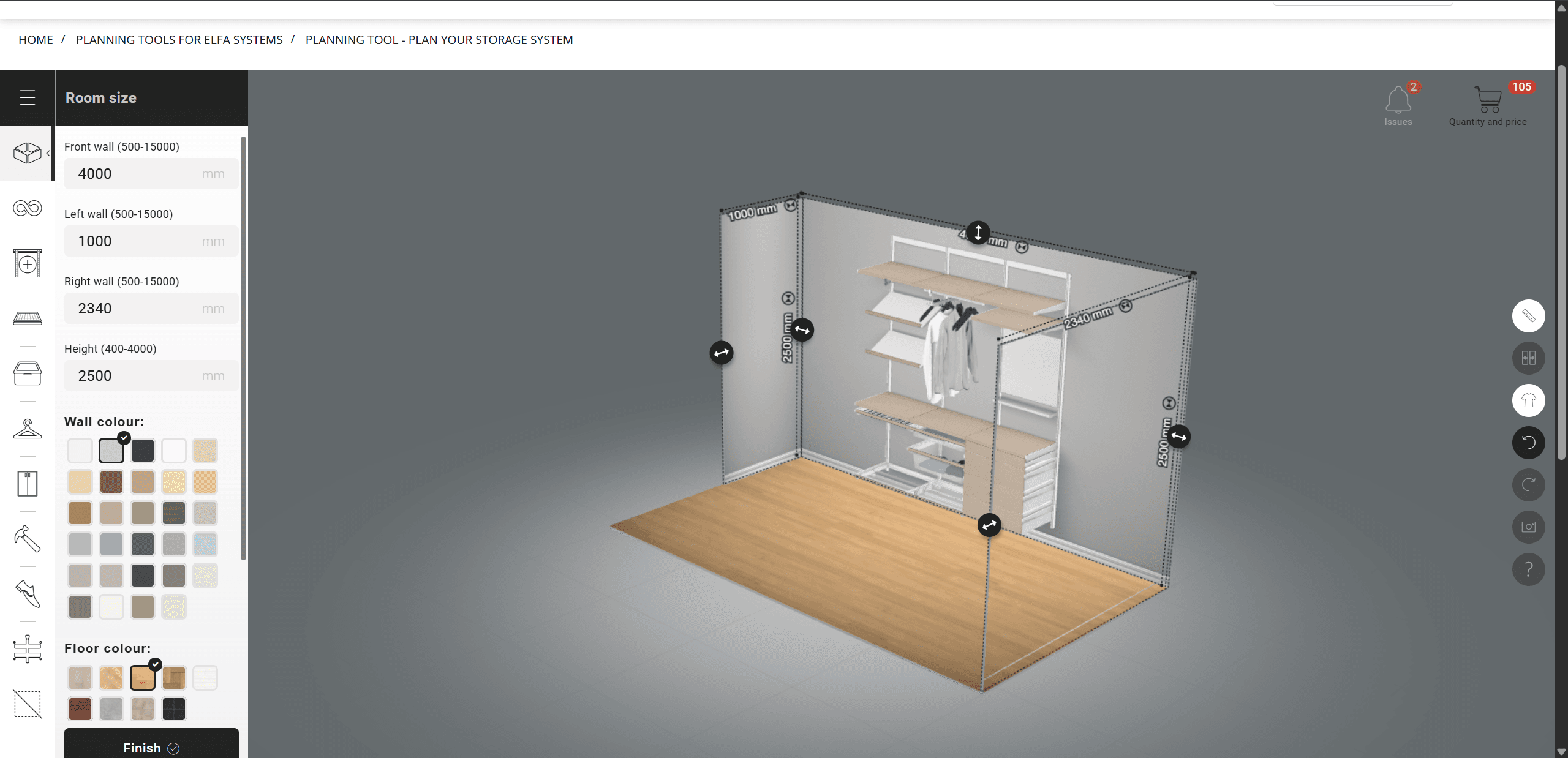
Elfa Storage System 3D Planning Tool
 Elfa
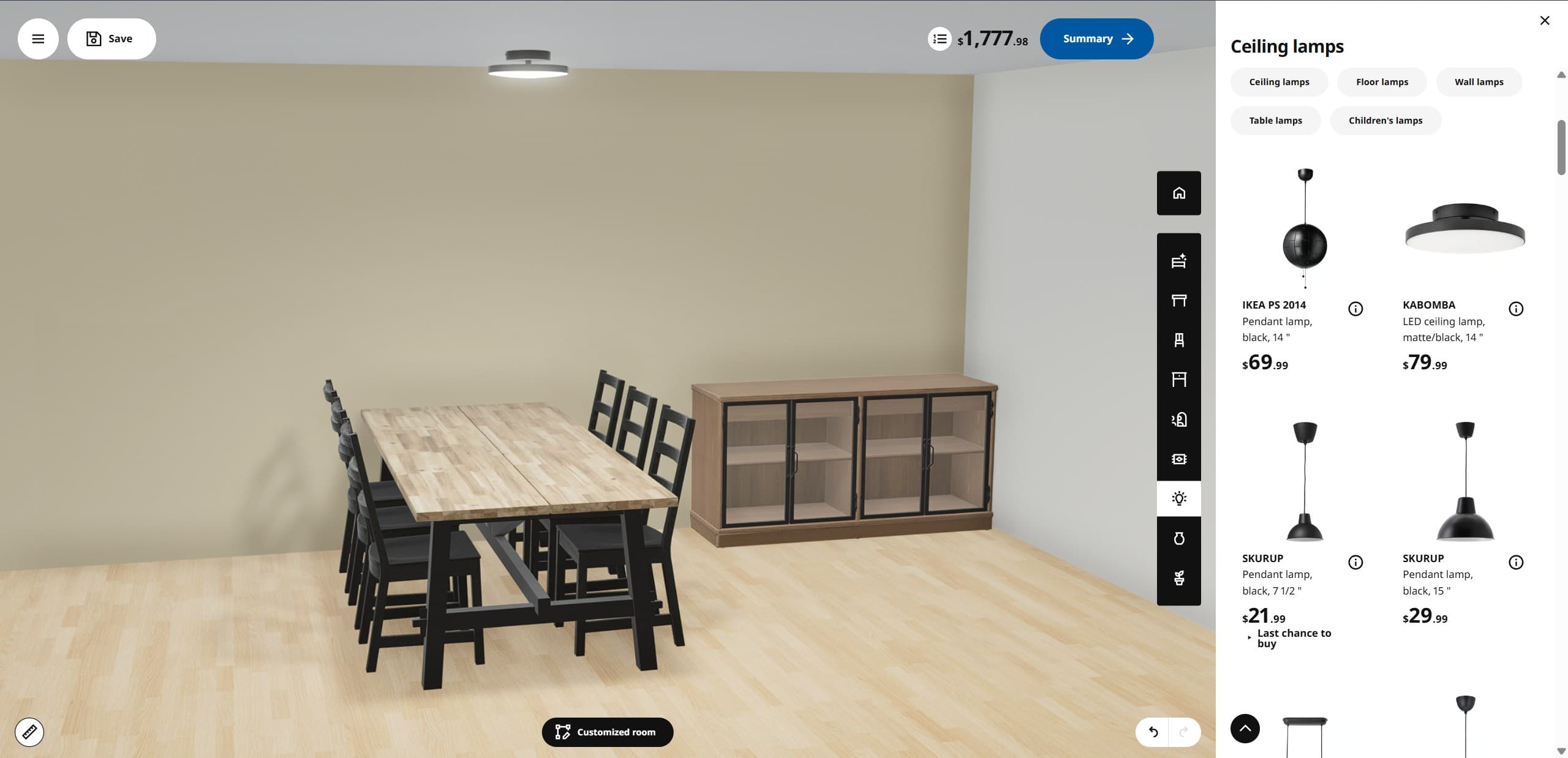
IKEA Planning Tools
 IKEA
Tylko 3D eCommerce Website
 Tylko

Pickawood Furniture 3D Configurator
 Pickawood
No single engine wins. Elfa runs on custom WebGL built by Animech, IKEA's planners on Babylon.js, and Tylko and Pickawood on Three.js. Across the category, Three.js leads with 13 of 24 furniture configurators, against 5 on Babylon.js.
For the comparison below, "top tier" means furniture configurators with an editorial score above 4 out of 5, currently 10. The other 14 are "the rest."
Table stakes: modular builds, live price, materials
Treat these as the entry ticket, not an edge. Pricing is where the top tier is most uniform: 10 of the 10 top-tier configurators update the price with every choice, against 8 of the other 14.
Modular assembly is the surprise, because it's slightly more common outside the top tier. Two of the top four don't build module by module. Tylko sizes a piece parametrically, and IKEA's planners place items freely on a canvas.
Of the furniture configurators we track, 13 end in a cart or checkout, 7 in a quote or lead form and 2 in a full CPQ flow. Schmidt's kitchen and wardrobe planners, built on Babylon.js by Hapticmedia, show the quote route can still reach the top tier. The ending shapes the build: a cart needs live prices, while a quote flow needs a clean handoff to sales.
The separators: saved designs and dimensions
Saved designs are the clearest dividing line in our data. In the top tier, 9 of 10 let shoppers save and reopen a design, against 3 of the other 14. Sharing a design by link follows the same pattern: 7 of 10 versus 3 of 14.
Furniture is rarely bought in one sitting. A saved design lets a shopper measure the alcove at home and come back without starting over. It also gives your sales team a configuration ID instead of a description in an email.
Dimensions on the model lean the same way, less sharply. In the top tier, 6 of 10 draw measurements on the model, against 4 of the other 14. Across all the furniture configurators we track, it's 42%.
For shelving and storage, a dimension overlay answers the question behind many wrong orders: will it fit? In our view, it's one of the cheapest ways to cut wrong-size returns, because the 3D model already knows its own size.
Flexcube's modular shelving planner puts the whole set in one Verge3D and Three.js build: dimensions, saved and shared designs, and a quote PDF.


Useful, but not what separates the leaders: rules, quote PDFs and AR
The last three traits appear across the category without tracking score. Of the furniture configurators we track, 46% enforce conditional logic, 21% export a quote PDF and only 8% offer an AR view.
Conditional rules matter more than their share suggests, because good ones are invisible. Shoppers notice them only when an option silently fails, which is what our feedback and constraints sub-score penalizes.
Quote PDFs earn their place when a person closes the sale, such as a kitchen planner, a dealer or an office fit-out. Elfa takes the same idea further: a finished design becomes a priced bill of materials, down to every bracket, that shoppers can print, email or take to a dealer.
AR is the rarest trait, and the research suggests care. An EMAC 2025 study found AR reduces returns only when it shows size accurately, while inaccurate sizing inflates expectations (EMAC, 2025, academic). A Journal of Marketing study found AR lifts sales most for niche, pricier products and for shoppers new to a channel (Kellogg School of Management, 2022, academic).
IKEA took room context furthest with Kreativ. It scans a room, erases the furniture already there and places IKEA items, using technology from Geomagical Labs, which IKEA acquired in 2020 (CXM Today).
For a smaller brand, an exact dimension overlay answers the same "will it fit?" question with far less work. In our view, it's the better first investment, with AR added once your dimensions are exact.
If you want every furniture listing's sub-scores side by side, including where a specific competitor lands, the scorecard has them.
Get the full Furniture & Workspaces scorecard
Every furniture & workspaces configurator we've scored, with all 10 sub-scores, tech stack and commerce setup, in one sortable sheet. Use it to see where your own sits against the leaders.
Real-time 3D or pre-rendered frame spins: which one are you looking at?
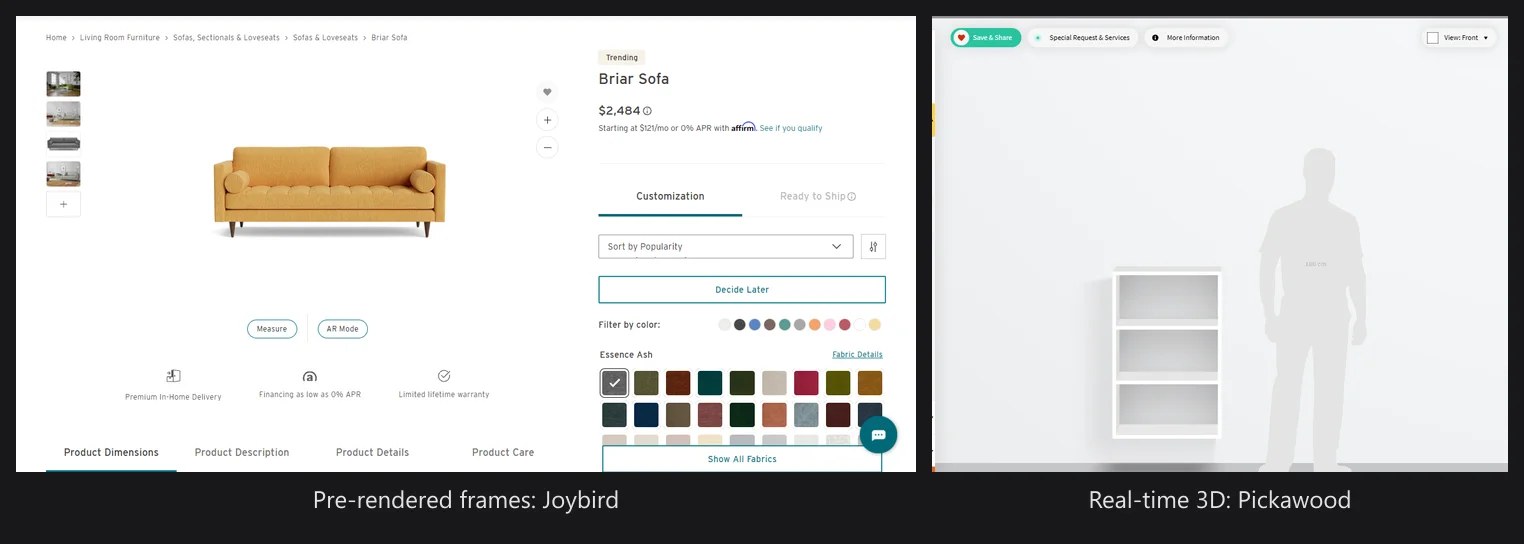
In our catalog, it's almost always real-time 3D: 23 of the 24 furniture configurators we track render the model live in the browser. Outside the catalog, many furniture brands use pre-rendered frame spins instead. Joybird's 360° sofa views, for example, are Cylindo frames rather than real-time 3D (Joybird, page source, October 2026).
That split isn't typical of configurators at large, and our catalog selects for browser 3D, so the skew is by design. In a 2021 study of the 97 most popular entries in the Configurator Database, 73.2% showed the product as flat 2D or layered images. Only 22.7% allowed 360° rotation (cyLEDGE, MCP-CE, 2022).
How each one works
A real-time configurator downloads the product as a 3D model, usually a GLB file with Draco-compressed geometry and KTX2 textures. Three.js or Babylon.js then draws every frame on the shopper's GPU through WebGL, so any size, module or fabric renders on the fly from any angle.
A frame spin is a stack of images rendered in advance on a server. Dragging swaps one image for the next, so it looks photoreal and loads like a gallery. The catch is that every option combination needs its own frames, and the camera can only go where the renderer went.
Cylindo, the platform behind Joybird's spins, lists Interior Define, EQ3 and Cozey among its customers (Cylindo). It's a mature approach, not a shortcut.
A third route, pixel streaming, renders on a cloud GPU and sends video to the browser over WebRTC. It's best known from car configurators, and only 3 listings across our whole catalog use it, none of them furniture at the time of writing. Our car configurator breakdown covers what it costs.
How to tell which one you're looking at
Open DevTools, switch to the Network tab and drag the product around. If a .glb or .gltf file loaded once and dragging triggers no new requests, it's real-time 3D. If each drag pulls in .webp or .jpg frames, it's a frame spin.
Two quicker tells work without DevTools. Frame spins usually rotate around one axis, and zoom often goes soft past the rendered resolution. A real-time model lets you look down from above.
Which one fits your product
The product decides more than the budget does. Frame spins suit a sofa sold in fixed sizes and many fabrics, where photoreal cloth matters more than free movement. Real-time 3D wins once shoppers set dimensions, because nobody can pre-render every width in centimeters.
That's why storage dominates the top of our furniture ranking. Cabinets and shelving account for 13 of the 24 furniture configurators we track, including all four leaders shown above.
Modular sofas sit in between. Vetsak's modular sofa configurator, built on Three.js by Vazco, lets shoppers drag seat modules into a layout with measurements shown, which a fixed frame spin can't do.


3D also holds attention. Google's own platform data showed shoppers engage almost 50% more with 3D images than with static ones (TechCrunch, 2022). That figure measures engagement, not sales.
Do furniture configurators work on mobile?
Mostly, but phones are the weak spot. Mobile is the lowest furniture sub-score in our October 2026 data at 3.67 out of 5, against 4.35 for stability. That matters because buying happens on phones: Wayfair says 64.9% of its Q4 2025 orders were placed on mobile (Wayfair Q4 2025 results, 2026).
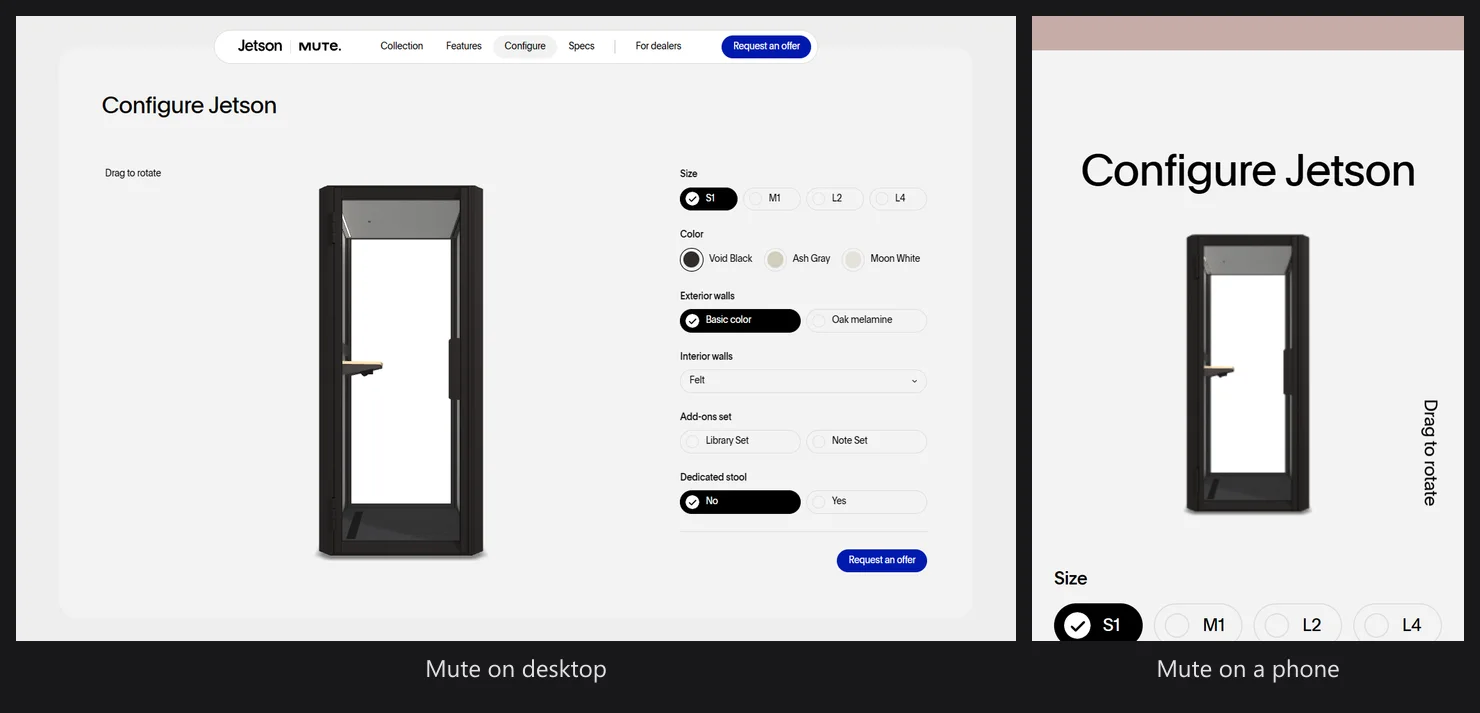
Furniture still beats the catalog as a whole, where mobile averages 3.53. Of the 24 furniture configurators we track, 9 score below 4 on mobile and 2 earn a full 5. At the time of writing, those are Elfa's planner and Mute's Jetson configurator.
Why 3D breaks on phones
Phones have less GPU memory and slower connections, so heavy models and uncompressed textures hit them first. Desktop-first layouts make it worse: option panels cover the model, and drag-to-rotate fights the page scroll.
Initial load feel trails as well, averaging 3.77 across furniture, and it's often the same problem showing up earlier. Speed carries a price on mobile: a Deloitte study commissioned by Google found a 0.1-second faster mobile site lifted retail conversion by 8.4% (web.dev, 2020).
How the leaders handle phones
In our data, asset strategy and mobile are among the sub-scores where the top tier pulls furthest ahead of the rest. Lean assets and a phone-first layout tend to arrive together.
There's more than one way to get there. Elfa's planner carries a guided wizard, dimensions and a priced parts list and still earns a full mobile score. Mute goes the other way, keeping its option list short enough to fit a phone screen.
If you're writing a brief, put mobile targets in it. Ask for Draco and KTX2 compression, LOD on detailed parts, a first-interaction budget on a mid-range phone over 4G and a layout tested at 390 px wide. Our mobile gap analysis goes deeper on the fixes.
What do office and workspace configurators do differently?
They sell to buyers who specify for a team, so they lean toward quotes and dealer handoff over a cart. Of the furniture configurators we track, 7 end in a quote or lead form, including both acoustic pod specialists, Mute and Framery.
ORGATEC, the office furniture trade fair, runs in Cologne from today until 30 October (ORGATEC, 2026). It's a good week to look at how workspace products sell online, with no booth and no sales rep.
Acoustic pods: Mute and Framery
Mute's Jetson configurator keeps the choices short: size, color, wall finishes, add-on sets and a stool, in a Three.js scene that ends in a request for an offer. It loads slower than the storage planners, yet earns a full mobile score and top marks for clarity. For a pod that a facilities manager might spec from a phone, that's a sensible trade.
Framery takes the specifier route. Its pod configurator offers presets, side-by-side comparison, snapshot export and a 3D model download, useful for architects placing a pod in their own plans. Comparison is rare in the category: only 2 of the furniture configurators we track offer it.
Desks and tables: modulor
modulor sells desks and tables straight to cart. Its Three.js configurator combines parametric sizes, conditional rules and dynamic pricing, and it sits in the top tier alongside the storage planners.

Mute Workspace Cabins Simple 3D Configurator
Mute

Framery Pod Configurator
 Framery

Modulor Tables & Desks 3D Configurators
modulor
How the large office brands build theirs
The large office brands we checked buy a platform rather than build from scratch. Herman Miller's Aeron page loads 3D Cloud by Marxent (Herman Miller, page source), and Steelcase's Gesture configurator loads Threekit's player (Steelcase, page source).
Vitra's Eames Plastic Chair uses an Emersya embed that pulls price and delivery time from Vitra's ERP and adds an AR view (Emersya). USM Haller's planner, built with EasternGraphics, the company behind pCon, adds live pricing, DWG, SKP and FBX downloads, and a handoff to a USM sales partner (USM, launch announcement).
If you sell through dealers or to specifiers, CAD export and dealer handoff can matter more than photoreal rendering. Browse the quote and lead configurators for B2B patterns, or see how each platform choice plays out in our five-brand furniture comparison.
Frequently asked questions
What is a furniture 3D configurator?
It's a browser tool that lets shoppers build a piece of furniture on a live 3D model, choosing modules, sizes and materials while the price updates. Of the 24 furniture configurators we track, 23 render real-time 3D with engines such as Three.js or Babylon.js. Others use 2D images or a mix of 2D and 3D.
What makes a good furniture configurator?
A good one renders every module and material change instantly, shows a live price, draws real dimensions and lets shoppers save their design. Saved designs separate the top tier most clearly in our data: 9 of the 10 furniture configurators scoring above 4 overall offer them. It also has to work on a phone.
How much does a 3D furniture configurator cost?
Cost depends on how many products you model, how complex the rules are and what the configurator connects to. VividWorks, a configurator vendor, puts setup for a simple build at €5K or more, a medium one at €15K or more and a complex one at €50K or more (VividWorks). Our configurator cost guide compares SaaS, agency and custom routes.
Is Three.js a good choice for a furniture configurator?
It's the most common choice in our data: 13 of the 24 furniture configurators we track use Three.js, against 5 on Babylon.js. Building on it gives full control over the interface and pricing logic. A SaaS platform usually gets you live faster, with less control.
Score your own furniture 3D configurator in 10 minutes
You can check your configurator against this benchmark in about 10 minutes with a phone and a laptop. Each check below maps to a trait from the data, from live pricing, which 75% of the furniture configurators we track offer, to AR at 8%.
- Phone first. Open it on a mid-range phone over cellular data. Note how long it takes before you can tap an option, and whether the panel hides the product.
- Live price. Add a module or change a size. The price should update without a reload.
- Dimensions. Resize something and check whether real measurements show on the model while you do it.
- Save and share. Save a design, close the tab and reopen it from the link. It should come back exactly as you left it.
- Rules. Pick an option that shouldn't fit. A good configurator explains why it's unavailable instead of silently doing nothing.
- Handoff. Check whether a shopper, dealer or sales rep can get a PDF, a quote or a configuration code.
- Rendering. Drag the product with DevTools open. One .glb file means real-time 3D; a stream of image frames means a frame spin.
- AR, if you have it. Place the product next to something you've measured. The two should match.
Most furniture configurators pass the price check. Saved designs, dimensions and the phone test are where scores split.
If you don't have a configurator yet, the same list works as a brief for whoever builds it. You can also describe your project to us.
If you already have one and want a second opinion, we'll score it on the same 10 sub-scores within 48 hours.
Score my configurator, free
Send us the link. Within 48 hours you get the same 10-point review every listing gets, the three changes that would lift your score most, and where you stand against the leaders in your industry.