Office Furniture Configurators Compared: Five Brands, Five Builds
Choosing how to build a furniture configurator is harder than deciding you need one, because most of the comparisons you'll find come from companies that sell the build. Emersya's own top-10 list of configurator examples features six projects built on Emersya (Emersya, updated October 13, 2026). VividWorks' list of the best furniture configurators gives six of its ten spots to its own clients (VividWorks).
So we looked instead at five furniture brands your boss has already heard of. Herman Miller, Steelcase, Vitra, USM and Joybird all sell configurable products online, and each chose a different way to build the office or home furniture configurator behind them.
None of the five is the wrong answer. Each fits a different way of selling, and the trade-offs only become clear when you line them up against the same questions.
The short answer: which approach fits which business
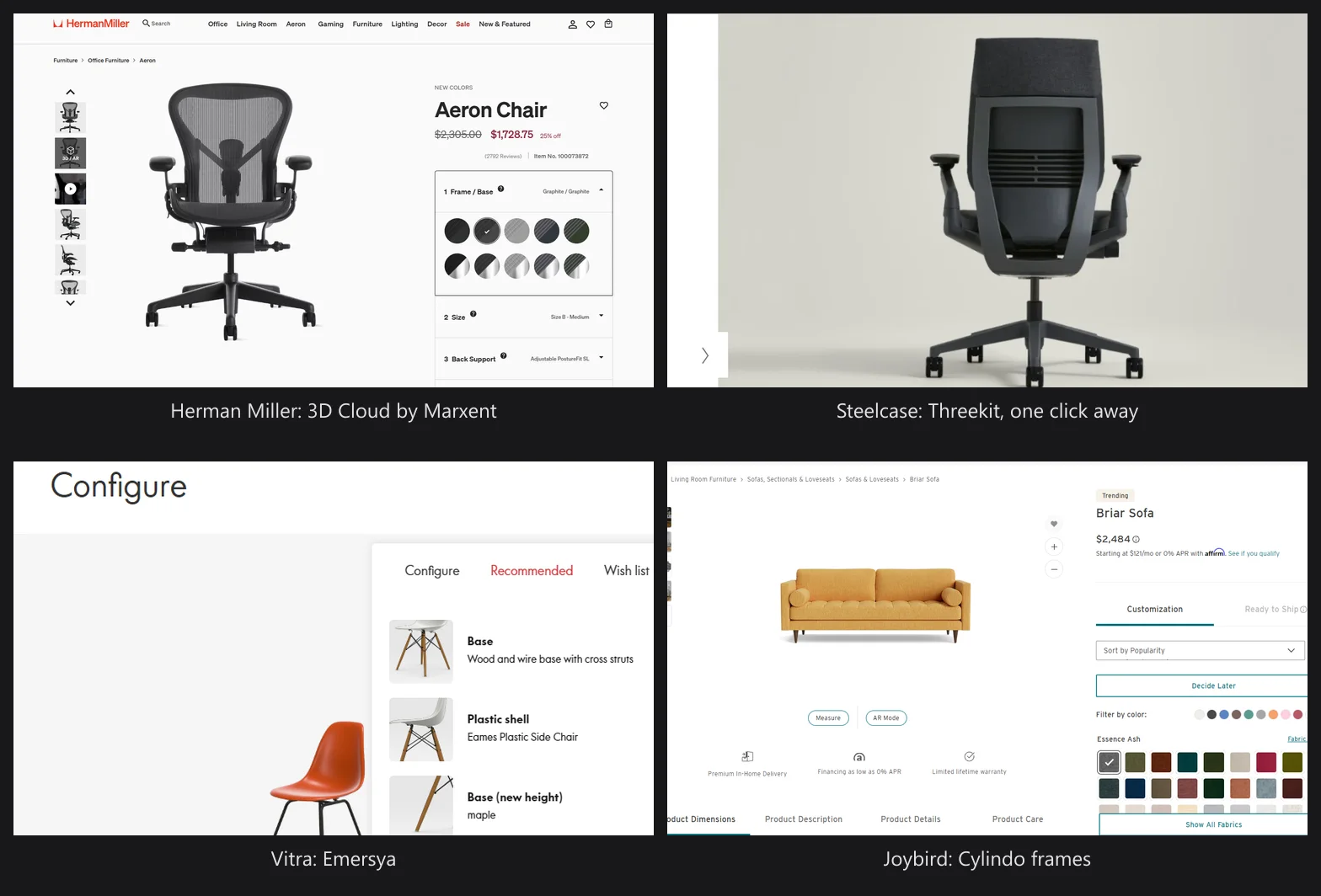
Five well-known furniture brands use five different configurator builds, and each choice follows how the brand sells. Herman Miller runs 3D Cloud by Marxent on the product page, and Steelcase runs Threekit in a configurator one click away.
Vitra ties an Emersya embed to its ERP for live price and delivery time. USM Haller's planner, built with EasternGraphics, exports DWG, SKP and FBX files for architects and dealers, and Joybird shows Cylindo's pre-rendered frames instead of real-time 3D.
Choose by sales channel first (cart, dealer or quote), then by how many variants you need to show. A smaller brand selling direct doesn't need any of these stacks: direct-to-consumer brands such as Tylko and Pickawood sit near the top of our furniture scores with real-time 3D configurators.
Side by side: five furniture configurators, seven questions
The table compares the five on what a buyer needs to know before choosing a build. Each cell comes from the brand's product page as loaded in October 2026, or from the vendor's or brand's public statement where noted below.
| Brand | What you configure | Platform | Real-time 3D or frames | Price shown | AR | B2B handoff |
|---|---|---|---|---|---|---|
| Herman Miller | Aeron chair options on the store page | 3D Cloud by Marxent | Real-time 3D | Yes, with cart | Yes, "View in Your Space" | Print-friendly summary; cart checkout |
| Steelcase | Gesture chair options | Threekit | Real-time 3D (Threekit player) | Yes, list price in the configurator; retail price and cart in the Steelcase Store | No (AR turned off for Gesture) | PDF with list price, share link, dealer quote request |
| Vitra | Eames Plastic Chair | Emersya embed | Real-time 3D | Yes, plus delivery time, both from the ERP | Yes | ERP-backed price and delivery time; cart or share with a retailer |
| USM Haller | Modular Haller storage | Built with EasternGraphics (maker of pCon) | 3D planner | Yes, live | Yes, AR room view | DWG, SKP and FBX export; pass to a sales partner |
| Joybird | Fabric and wood stain, such as on the Briar sofa | Cylindo | Pre-rendered 360° frames | Yes, changes with fabric | Yes, an "AR Mode" button | Consumer cart |
How we identified each stack
We didn't rely on vendor case studies. In October 2026, we read each product page's source and the vendor scripts it loads.
Two signals give a build away. Vendor scripts name the platform, and asset types reveal the rendering: .glb or .gltf files feeding a WebGL canvas mean real-time 3D, while a run of .webp or .jpg frames swapped as you drag means a pre-rendered spin.
For Vitra and USM, the platform is also public. Emersya presents its Vitra project on its own site, and USM named EasternGraphics in its launch announcement.
Brand by brand: strengths and trade-offs
We've scored one of the five so far. Herman Miller has a live listing; the other four aren't listed yet, so we compare their build choices and give them no score.
Herman Miller: 3D Cloud by Marxent on the product page
Herman Miller's Aeron product page loads 3D Cloud by Marxent, according to its page source (Herman Miller). The configurator lives on the store's product page, with price and checkout in the same flow, so shoppers don't have to hunt for a separate tool. Our listing was scored on the Embody Gaming Chair page, which runs the same 3D Cloud configurator as the Aeron page.
What it does well. Our listing scores solidly on stability, clarity and findability, and it records live price calculation. The page also offers a print-friendly summary of the chosen setup and a "View in Your Space" AR option. A hosted 3D platform spares the brand from running its own asset pipeline across a large range of chairs and finishes.
The trade-off. At time of writing, the listing sits in the lower part of our furniture rankings, with initial load feel and interactivity as its weakest sub-scores. In practice that means a slower first view and fewer ways to handle the chair than the top-scored furniture builds offer.


Steelcase: Threekit behind a "Configure Now" button
Steelcase's Gesture page loads Threekit's player in its page source, and its "Configure Now" button opens a Threekit configurator on a separate Steelcase page (Steelcase). Like Herman Miller, Steelcase rents its configurator from a platform rather than building it, but it picked a different one.
What it does well. A platform player keeps product rules and 3D assets outside the web page itself. That separation generally makes it easier to reuse one configurable product across a brand site, a store and internal sales tools.
The trade-off. Any third-party player adds a script bundle you don't control, so load feel and release timing partly depend on the vendor. We haven't scored Steelcase yet, so we won't guess at a number.
Vitra: Emersya wired into the ERP
Vitra's Eames Plastic Chair configurator is an Emersya embed whose price and delivery time update with every choice, pulled from Vitra's ERP (Emersya). It also offers an AR view, so shoppers can place the chair in their own room.
What it does well. Live delivery time answers the question shoppers would otherwise email about: when will it arrive? AR suits a design-led chair too, since a Journal of Marketing study found AR lifts sales most for niche, pricier products and for customers new to a channel (Kellogg School of Management, 2022).
The trade-off. In our experience, an ERP connection is the hardest part of a build like this, and it fails quietly. If lead times are wrong in the ERP, the configurator shows the wrong date with full confidence.
AR carries a similar risk. An academic EMAC 2025 paper found AR reduces returns only when it shows size accurately, and that inaccurate sizing inflates expectations (EMAC 2025).
USM Haller: a planner that ends with a dealer
USM's Haller planner lets buyers design modular storage with a live price, download it as a 2D or 3D model, and pass it to a USM sales partner (USM). USM's launch announcement says it built the planner with EasternGraphics, the company behind pCon, and lists DWG, SKP and FBX among the formats (USM, archived).
What it does well. The output is something the next person can use: a file an architect can drop into AutoCAD, SketchUp or a 3D tool, plus a handoff to the dealer who will quote and install it. For a modular system sold through dealers, that matters more than a prettier render.
The trade-off. A planner asks more of a casual visitor than a product page does. In our experience, the deeper the planning tool, the more it needs presets and guidance so first-time visitors don't stall at a blank starting point.
Joybird: Cylindo frames instead of real-time 3D
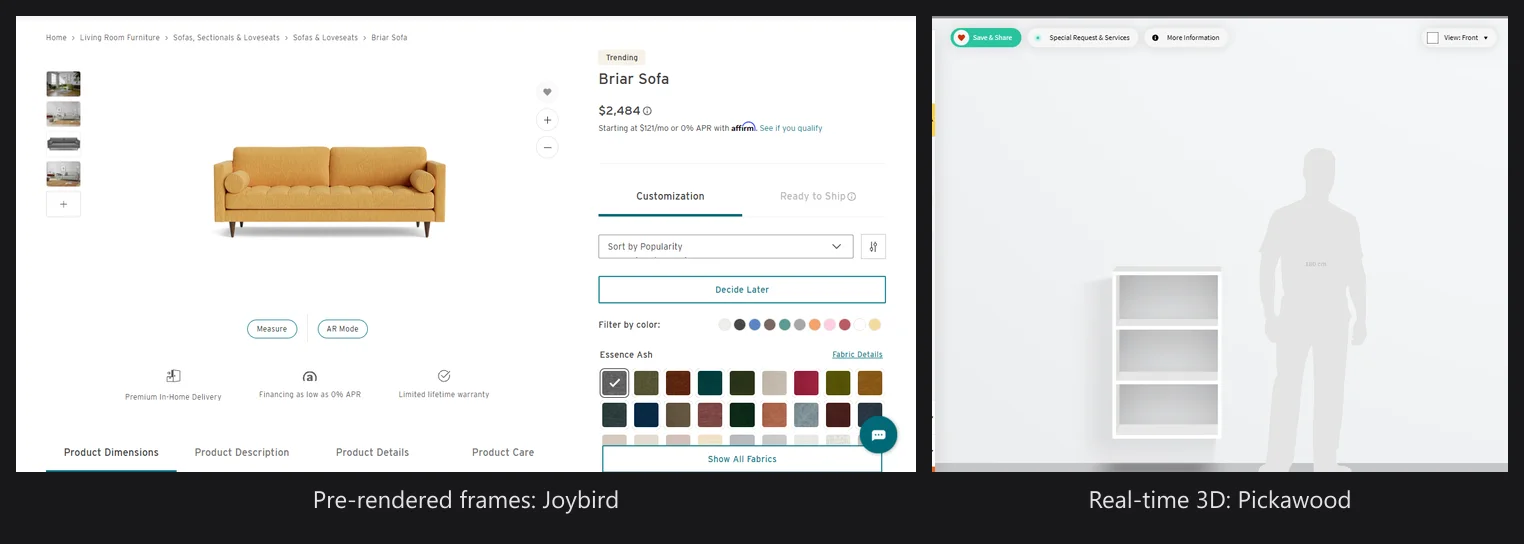
Joybird's sofa pages, such as the Briar sofa, show 360° spins made from Cylindo's pre-rendered frames rather than real-time 3D, as the page source shows (Joybird). Cylindo lists Interior Define, EQ3 and Cozey among its other customers (Cylindo).
What it does well. Every angle is a finished offline render, so fabric texture, seams and lighting look like product photography on any phone. Frames are ordinary images, so the shopper's device does no 3D work and there's very little that can crash.
The trade-off. Shoppers only see the angles and options that were rendered in advance. Frames alone can't go into AR, so Joybird's AR Mode needs a separate 3D model behind the spin. Every new fabric multiplies the frames to render and store, which works for a sofa line but gets heavy for a modular system with thousands of combinations.
Real-time WebGL vs pre-rendered frames: what do shoppers notice?
Most configurators on the web still aren't real-time 3D. In a 2021 study of the 97 most popular entries in the Configurator Database, 73.2% showed the product as flat 2D or layered images and only 22.7% allowed 360° rotation (cyLEDGE, MCP-CE 2022).
Furniture leaders have moved further. 100% of the 25 furniture configurators we track render real-time 3D in the browser (Active listings, October 2026; how we score). We curate for 3D, so read that as a picture of where the leaders are, not a market estimate.
The first view
Frames usually win the first second. The opening frame is an ordinary image, while a real-time view has to download meshes and textures before it can draw anything useful.
That delay costs money on phones. A Deloitte study commissioned by Google found that a 0.1-second faster mobile site lifted retail conversion by 8.4% across 37 brands (web.dev).
Real-time builds narrow the gap with Draco-compressed GLB meshes, KTX2 textures and level-of-detail (LOD) models that show a light version first. Even so, initial load feel averages 3.76 out of 5 across our furniture listings, so most builds still have room to improve.
Freedom to look around
Real-time 3D wins once the shopper starts exploring. They can orbit to any angle, zoom into a joint, open a drawer, or watch dimensions update as a module snaps on.
Google reported that shoppers engage almost 50% more with 3D images than with static ones, based on its own platform data (TechCrunch, 2022). Frames can't follow a shopper off the rendered path, so they suit products with a fixed shape and few moving parts.
The phone in their hand
Phones are where the difference shows most. Wayfair reported that 64.9% of its Q4 2025 orders were placed on mobile (Wayfair Q4 2025 results).
At time of writing, mobile is the weakest of our ten sub-scores across furniture listings, averaging 3.66. Frames hold up on cheap phones, while real-time 3D needs a mobile asset budget written into the brief rather than added after launch (more on the mobile gap).
When frames are the right call
Frames make sense when the range is mostly fabric and color on a fixed shape and photo-grade imagery is the selling point. Real-time 3D makes sense when shoppers change size, layout or modules, which is why 88% of the furniture configurators we track support modular assembly.
B2B handoff: what should an office furniture configurator send to dealers?
An office furniture configurator should end with something a dealer or specifier can act on, not just a good-looking view. That's still uncommon: only 20% of the furniture configurators we track export a quote PDF, and only 4 offer a 3D model download. That makes USM's DWG, SKP and FBX export, with a handoff to a sales partner, stand out (USM).
Office furniture is often specified by a designer or facility manager and bought through a dealer. So the configurator's job doesn't stop at "looks right": it has to produce something the next person in the chain can use.
Three levels of handoff
- A summary or quote PDF. The buyer forwards a spec to a manager or dealer, and it's the cheapest handoff to build. Steelcase's configurator exports a PDF with list price and sends quote requests to dealers, while Herman Miller's store offers a print-friendly summary that a shopper can print or save (quote PDF examples).
- CAD and 3D files. USM's DWG, SKP and FBX export lets an architect place the exact configuration in a floor plan instead of redrawing it. Fewer redraws mean fewer transcription errors between the plan and the order.
- A structured order. USM's handoff to a sales partner and Vitra's ERP-backed price and delivery time connect the configurator to operations. This level usually delivers the most value and costs the most to build.
Across our furniture listings, 13 configurators end in a cart, 8 in a quote or lead form and 2 in a CPQ flow. If you sell through dealers, write the handoff into the brief before you choose a renderer.
The file your dealers need will narrow the platform list faster than any visual comparison. Integration is also one of the main cost drivers, which we break down in what a 3D product configurator costs.
What does this mean for a smaller brand?
You don't need an enterprise platform or an ERP integration to sell configurable furniture well. VividWorks, a configurator vendor, puts setup for a simple build at €5K or more, a medium one at €15K or more and a complex one at €50K or more (VividWorks). Meanwhile, some of the best-scored furniture configurators we track belong to direct-to-consumer brands.
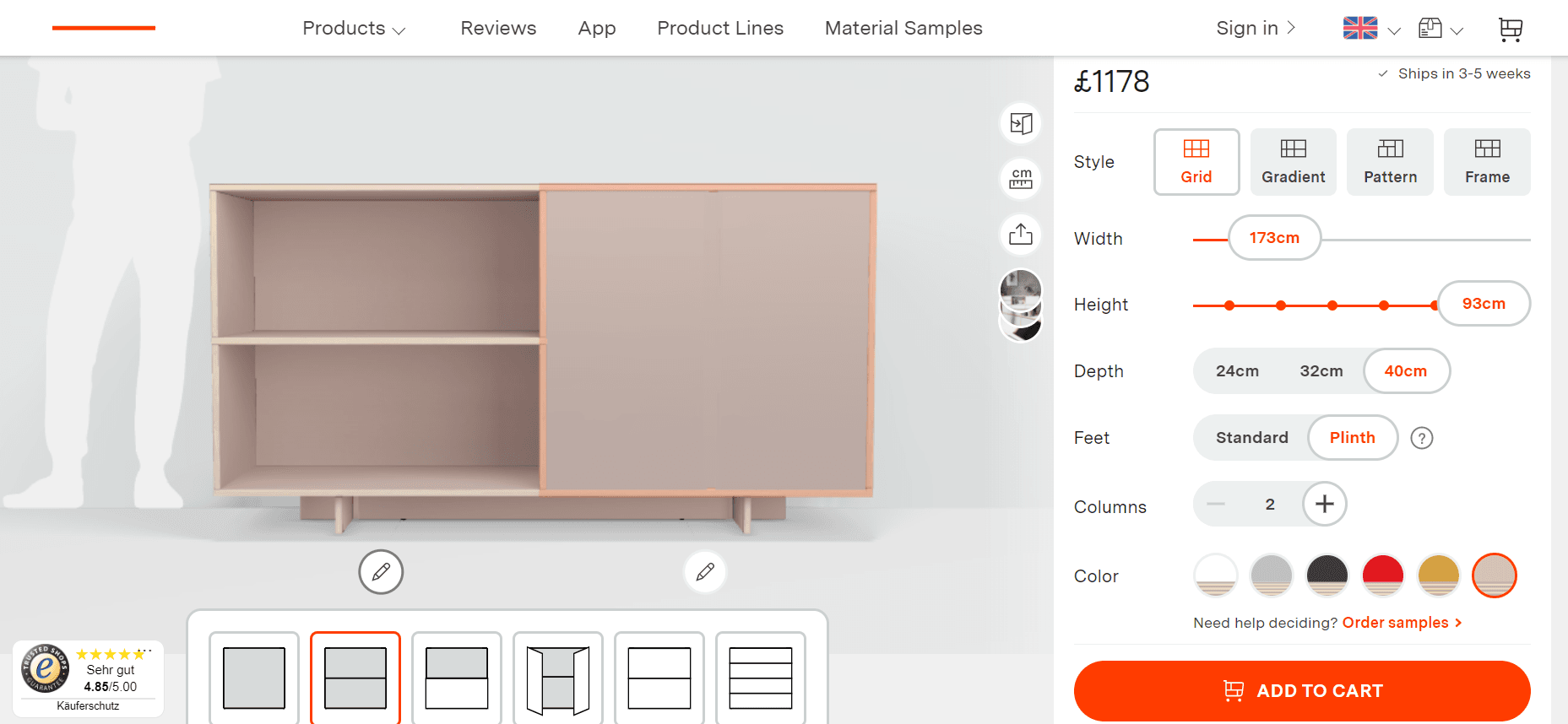
Tylko and Pickawood both run on Three.js, recalculate price as shoppers change dimensions, and show a measurement overlay. Mute keeps its acoustic-cabin configurator simple, ends in a quote request, and earns one of the top mobile ratings in the category.
Tylko 3D eCommerce Website
 Tylko

Pickawood Furniture 3D Configurator
 Pickawood

Mute Workspace Cabins Simple 3D Configurator
Mute
Three.js is the most common engine in the category: 13 of the 25 furniture configurators we track use it. For a small team, that means hiring for a widely used open-source library rather than a niche stack.
What to copy from the five
- From Herman Miller: put the configurator on the product page, not behind a separate "design tool" link.
- From Vitra: show the price on every change, and delivery time if your systems can supply it. 72% of the furniture configurators we track already show price as you configure.
- From USM: decide what the configurator hands off (cart, quote PDF or CAD file) before you decide how it renders.
- From Joybird: if your range is fabric on a fixed frame, pre-rendered frames may be enough, and they're kind to phones.
For the wider benchmark, see what the best-scored furniture configurators have in common, or browse furniture and workspace configurators by score. If you're ready to scope one of your own, you can describe your project here.
Benchmark your own configurator
If you already run a configurator, the quickest way to see where it stands against these five is to score it the way we score every listing. Send us the URL and we'll review it on the same ten sub-scores from our published methodology, with results within 48 hours.
Score my configurator, free
Send us the link. Within 48 hours you get the same 10-point review every listing gets, the three changes that would lift your score most, and where you stand against the leaders in your industry.