3D Product Configurator Cost in 2026: SaaS vs Custom vs Agency

Someone above you has asked what a 3D product configurator will cost, and every vendor page you open answers with "it depends." It does depend, but on fewer things than most quotes suggest. With 2027 budgets being set now, this guide puts published ranges next to the factors that actually move them.
The price follows three things: your 3D assets per SKU, your rules logic and your cart or CPQ integration. The rendering engine, whether Three.js, Babylon.js or PlayCanvas, barely moves the number. We compare four ways to get a configurator built, using vendor ranges and what we see across the 140 live configurators and 3D viewers we score.
At a glance
- Cost follows 3D assets per SKU, rules logic and integration. The engine barely matters.
- Setup fees start around €5K for a simple configurator and €50K for a complex one, per VividWorks. Software fees come on top.
- SaaS is cheaper to start and pricier at scale. Custom is the reverse.
- Budget for asset prep, catalog updates and maintenance after launch.
The short answer: how much does a 3D product configurator cost?
Configurator vendor VividWorks puts setup for a simple configurator at €5K or more, a medium one at €15K or more and a complex one at €50K or more. Those figures cover implementation only.
For custom studio builds, the industry range is $10K–40K for a typical single-product-family configurator. License fees, asset updates and maintenance come on top.
Where you land inside a band depends on unique 3D parts, rules and integration. Hosting a WebGL configurator is cheap, and the engine itself is free.
| Scope | What it usually includes | Setup fee (VividWorks) |
|---|---|---|
| Simple | Products with limited options, such as a sofa with a few layouts and fabrics; little or no ecommerce integration | From €5K |
| Medium | Modular products such as shelving; ecommerce integration, sometimes ERP or CRM | From €15K |
| Complex | Highly configurable products such as kitchens; custom workflows and deep integrations | From €50K |
These are starting prices for setup. VividWorks bills its monthly software fee, which covers hosting, updates and support, separately.
Treat these as vendor ranges, not quotes. When proposals come in, ask whether each one includes 3D asset production, integration work and the first year of license fees, because those lines are usually where totals diverge.
What are the four ways to get a 3D configurator built?
You can license a platform, pay an agency to build on a platform, commission a custom build or hire your own team. Big furniture brands are split: Herman Miller uses 3D Cloud by Marxent, Steelcase uses Threekit, Vitra uses Emersya and USM built its planner with EasternGraphics, the maker of pCon. Each route trades upfront cost against ongoing cost and control.
We look at those brands side by side in five furniture configurators, five build choices.
SaaS platform
You license a configurator platform, supply or commission the 3D models, and embed its player on your product pages. It's the fastest and cheapest route to launch, and the vendor handles hosting, browser updates and often AR files.
The catch is the recurring fee and the platform's limits on UI and rules. Read the pricing basis twice: VividWorks sells monthly plans from €447 that cap yearly views and 3D assets, and Zakeke charges by published products plus a fee on each custom sale. Threekit, Emersya and Expivi quote on request. Ask, too, whether you can export your GLB files if you leave.

Rep Fitness Rack 3D Configurator
 Rep Fitness

TaylorMade Golf Gear 3D Configurators
TaylorMade

Yeti Custom Shop Cooler 2D Configurator
Yeti

Beyerdynamic MMX 3000 Headphones 3D Configurator
 Beyerdynamic
REP Fitness, TaylorMade and YETI run on Threekit, and beyerdynamic runs on Emersya. YETI's Custom Shop sends the browser rendered images rather than a 3D scene, which is why our catalog labels it 2D.
Platform plus agency
An agency builds on top of a platform: custom UI, rules, cart integration and often the 3D assets. You pay the license and a project fee, so year one costs more than plain SaaS, but the experience looks like your brand rather than the vendor's player.
The dependency is the risk. If the platform raises prices or changes terms, the agency's work rarely moves with you, so get your assets and rules data in a format you can take elsewhere.
Custom studio build
A studio builds the configurator on an open-source engine such as Three.js, Babylon.js or PlayCanvas, and you usually own the code and the assets. Industry ranges put a typical single-product-family configurator at $10K–40K, paid mostly up front.
After launch, a real-time WebGL configurator is a set of static files on a CDN, and the shopper's device does the rendering. Running costs are hosting plus a maintenance retainer or ad hoc fixes.
Elfa Storage System 3D Planning Tool
Elfa

NORQAIN Watch Configurator
 NORQAIN

Vetsak Sofa Configurator
 Vetsak

Flexcube Modular 3D Configurator
Flexcube
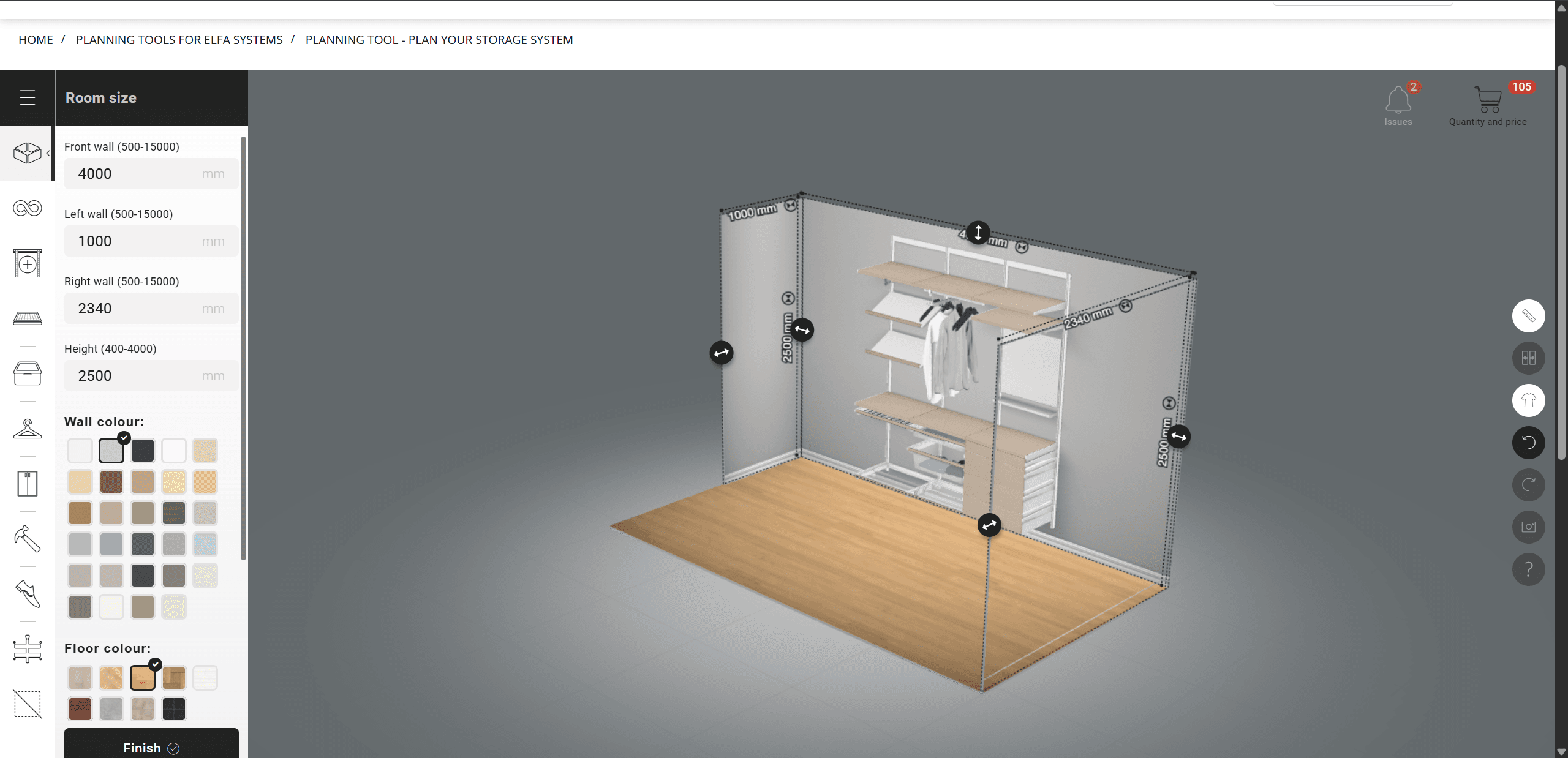
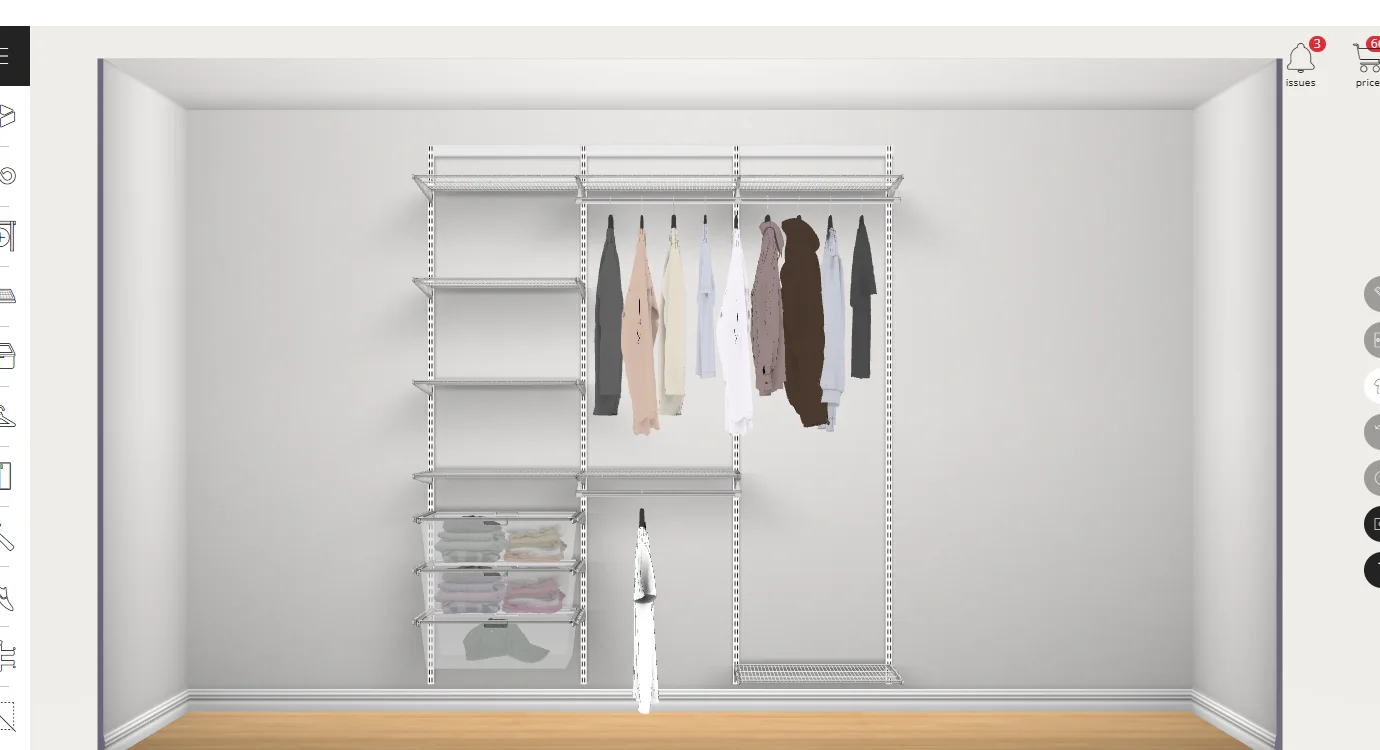
Elfa's planner, NORQAIN's watch builder, Vetsak's sofa configurator and Flexcube's modular planner are custom builds by outside studios, on custom WebGL, PlayCanvas, Three.js and Verge3D.
In-house team
You hire or assign a WebGL developer, a 3D artist and part of a backend developer's time. It's the most expensive way to ship version one and often the cheapest way to run version ten, if new products arrive every season.
The risk is concentration. WebGL specialists are hard to hire, and when one leaves, the roadmap can stall with them.
| Route | Upfront | Ongoing | What you own | Fits best when |
|---|---|---|---|---|
| SaaS platform | Lowest | Yearly license | Depends on contract; ask about GLB export | You're testing 3D, or the catalog is small and stable |
| Platform + agency | Medium | License plus agency retainer | Assets, sometimes the UI code | You want a branded UX without running infrastructure |
| Custom studio build | $10K–40K typical per product family | Hosting plus maintenance | Code and assets, if the contract says so | Rules or integration are complex, or the catalog will grow |
| In-house team | Highest | Salaries | Everything | The configurator is your main sales channel |
What actually drives 3D product configurator cost?
Three things set the price: the unique 3D parts and materials your catalog needs, the rules that connect options and the system a finished configuration goes to. Across our catalog, 30% of live configurators use conditional logic and 54% calculate a price, and each of those adds build work on any route.
The engine is not on the list. Three.js, Babylon.js and the PlayCanvas engine are open source, and as we show below, the scores they produce sit close together.
3D assets per SKU
Count unique parts and materials, not SKUs. A sofa sold in four sizes, 12 fabrics and three leg finishes is 144 SKUs, yet only four frame models, one leg model and 15 materials to build.
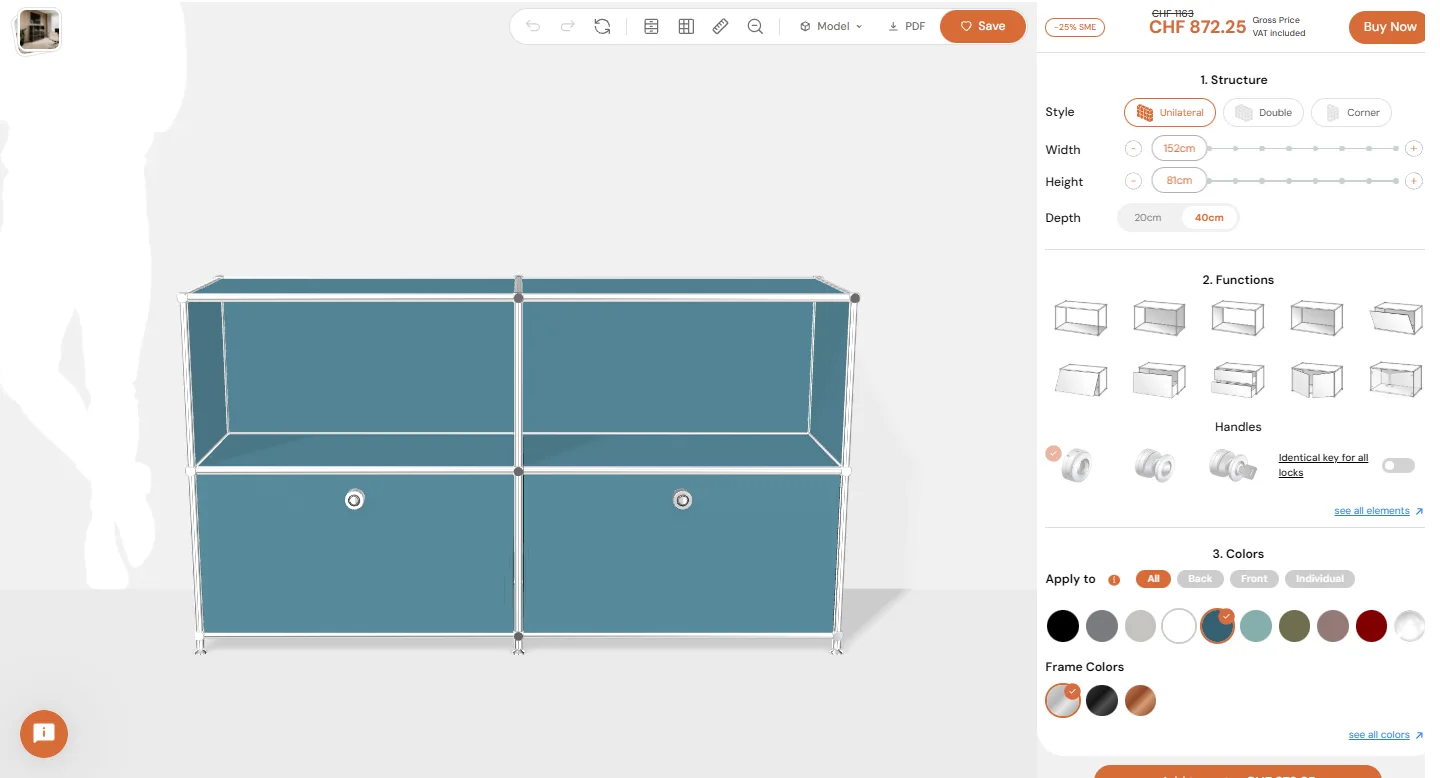
Geometry variants multiply cost; material variants are cheap. Furniture feels this most, since 88% of the furniture configurators we track support modular assembly and every module is new geometry.
Rules logic
Color swaps need no logic. "This leg only fits the long frame" does, and so does a price that changes with width. Someone has to write, test and maintain those rules against the price list.
Even car makers find this hard. A Simon-Kucher study of 46 brands (2023) found that equipment dependencies still frustrate configurator users. In furniture, 44% of the configurators we track use conditional logic.
Cart, CPQ or ERP integration
A configurator that ends in a quote form is cheap to connect. One that drops a priced, configured item into a cart is not. Across our catalog, 39% of configurators hand off to cart or checkout, 26% to a quote or lead form and 11% to a CPQ system.
If you want a 3D configurator for Shopify, plan how price and parts list travel with each line item.
Shopify caps a product at 2,048 variants, so most builds attach the configuration as line item properties and price it with a Cart Transform function that splits the line into priced parts, or with a draft order. Overriding a line's price outright needs Shopify Plus. At the top end, Vitra's Eames chair configurator updates price and delivery time from the ERP with every choice, and USM's planner exports DWG files and passes designs to a sales partner.
Mobile performance
Mobile is the weakest sub-score across our catalog, averaging 3.55 out of 5. Wayfair placed 64.9% of its Q4 2025 orders on mobile, and a Deloitte study commissioned by Google tied a 0.1-second faster mobile site to 8.4% more retail conversions.
Getting phones right is effort, not license: Draco-compressed geometry, KTX2 textures, level-of-detail (LOD) models and a UI that fits a thumb. Our mobile gap analysis shows where configurators lose people.
When does SaaS stop being the cheaper option?
SaaS usually wins year one, and custom usually wins once the catalog grows and the configurator stays. With setup fees starting around €5K for a simple build (VividWorks, vendor), a platform gets you live fastest. Its license repeats every year, while most of a custom build's cost is paid once.
A quick payback test helps. Subtract the platform's setup fee from the custom build cost, then divide by the yearly license minus the yearly custom maintenance. The result is the number of years before custom becomes cheaper.
If that's shorter than the time you expect to run the configurator, custom wins over its life. If your catalog is small and stable, or you're still testing whether 3D sells, the freedom to cancel a platform is worth paying for.
Scale widens the gap. Platform fees can grow with your catalog and traffic: VividWorks' plans cap yearly views and 3D assets, and Zakeke's tiers rise with the number of published products. A real-time WebGL configurator renders on the shopper's device, so extra traffic costs little beyond CDN bandwidth.
Which costs show up after launch?
The quote covers launch; the recurring costs keep the configurator accurate. Catalog updates, asset re-exports, browser changes and, for streamed configurators, server GPUs all repeat. BMW's streamed configurator runs one cloud GPU per user and handled up to 500 parallel sessions on launch day, according to AWS.
Turning CAD into web-ready GLB
Many brands start from CAD, and CAD is built for manufacturing, not browsers. Each part needs decimation, UV unwrapping and PBR materials, then export to GLB with Draco or Meshopt compression, KTX2 textures and lighter LOD versions for phones.
This is per-part work, so it scales with unique parts and repeats whenever engineering changes a part. Ask who owns the pipeline and the source files after launch.
Catalog updates
New fabrics each season, retired SKUs and price changes all need new models, updated rules and a test pass. Before you sign, ask who does this work, what one new model costs and how long a new material takes to go live.
Maintenance
Browsers change how WebGL and WebGPU behave, an iOS release can change how Safari handles memory, and engines ship new versions. On SaaS this sits inside the license; on a custom build, budget a retainer or a yearly review.
Streaming: a GPU for every visitor
Pixel streaming renders the scene on a server and sends video to the browser over WebRTC. BMW's EVE configurator runs Unreal Engine on AWS g4dn.2xlarge instances, assigning one GPU per user from a pre-warmed pool (AWS).
So cost grows with every concurrent visitor. Multiply peak sessions by the hourly instance price, $0.752 for an on-demand g4dn.2xlarge on Linux in AWS's US East region in October 2026 (AWS), and by the hours the pool stays warm.
Only 4 of the 140 configurators we track stream pixels, while 117 render real-time 3D on the shopper's device. We break down that split in how car configurators render.

Does a bigger budget buy a better configurator?
Not by itself, and the engine choice doesn't either. In our catalog, Three.js builds average 3.92 overall on a 1–5 scale, Babylon.js builds 4.08 and custom WebGL builds 3.88. The spread inside each engine is far wider than the gap between them.
What money buys is the work around the engine: lean assets, clear rules, a phone layout and decision aids such as live price and saved designs. At the time of writing, the three top-scored listings use three different engines.
Nike By You 3D Shoes Configurators
Nike
Elfa Storage System 3D Planning Tool
Elfa
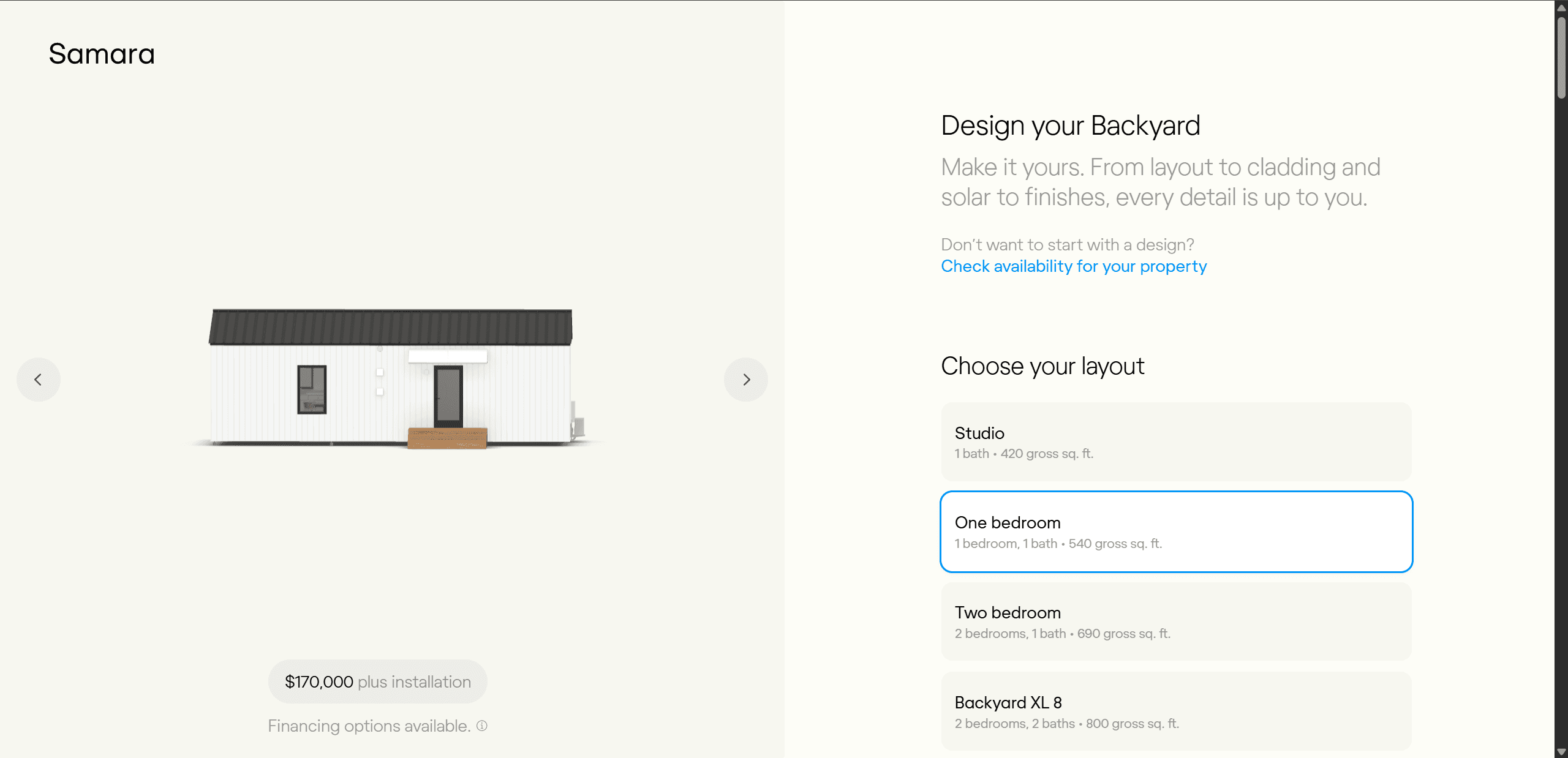
Samara Backyard Hybrid 3D&2D Configurator
Samara
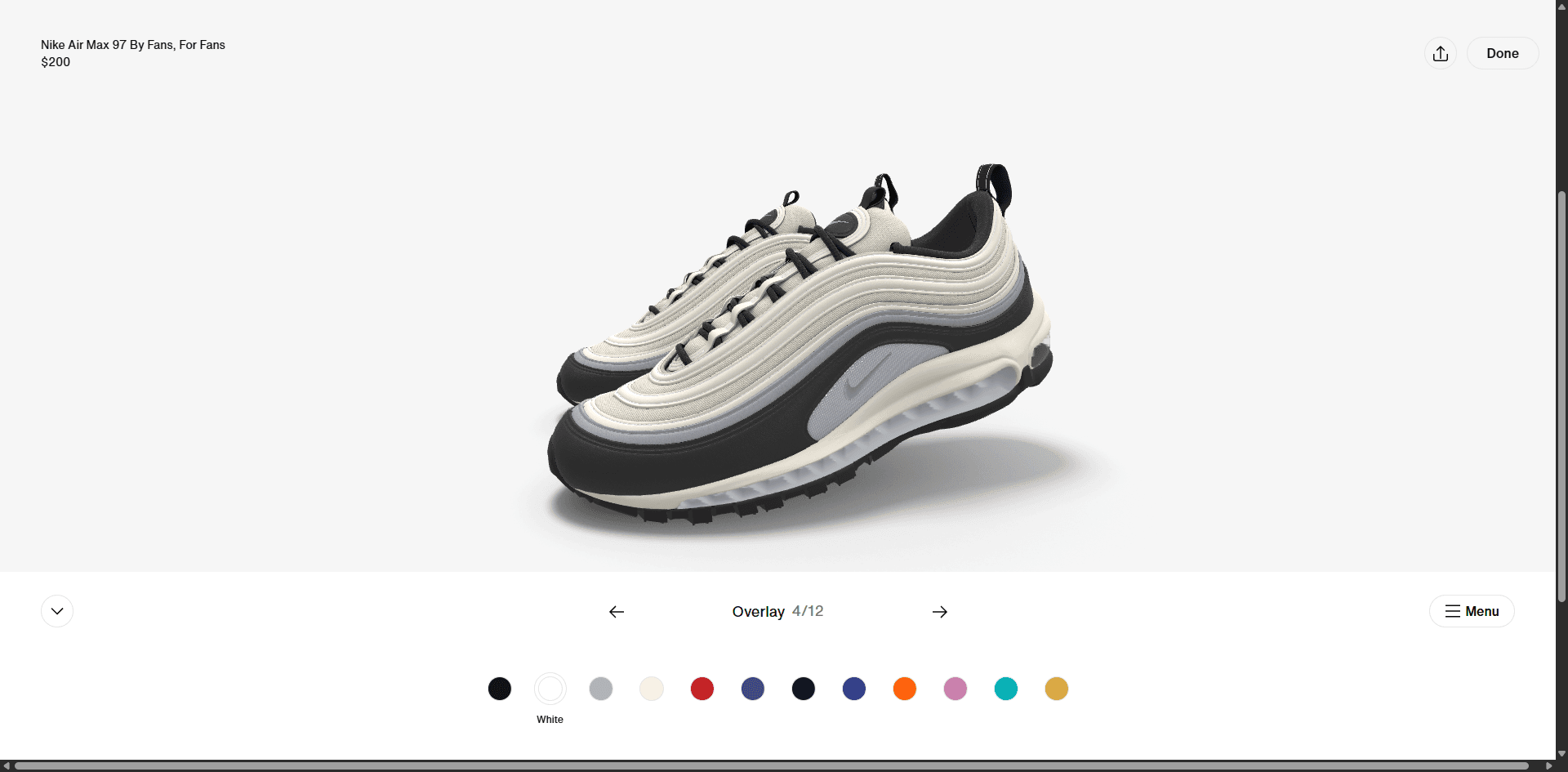
Nike By You runs on Babylon.js, Elfa on custom WebGL and Samara on Three.js. Our furniture benchmark shows which traits the category leaders share.
For the business case, use numbers you can defend. Shopify's Rebecca Minkoff case study (platform data) reports 44% more add-to-carts and 27% more orders from 3D interaction, and Google's 2022 data shows shoppers engage almost 50% more with 3D than with static images.
You'll also see "94% higher conversion with 3D" on many vendor pages, but Shopify's page gives no source for it, so keep it out of your deck. Returns are a steadier target: NRF and Happy Returns put US online returns at 19.3% of sales in 2025, and fewer wrong orders is what a good configurator aims at.
A simple way to estimate your range
Answer three questions and take the highest tier you hit. Each tier lines up with the VividWorks setup fees in the table below, and a custom single-product-family build typically lands at $10K–40K.
1. How many product families and unique parts? Count frames, modules and materials, not SKUs. One family with material swaps is simple; modular systems and parametric sizes push you up.
2. How complex are the rules? Free choice of colors is simple. Options that require or exclude each other, or prices that change with dimensions, are medium or complex.
3. Where does the configuration go? A quote form or email is simple. A priced cart line on Shopify or WooCommerce is medium; CPQ, ERP or a dealer handoff with CAD export is complex.
| Question | Simple | Medium | Complex |
|---|---|---|---|
| Product families and unique parts | One family, mostly material swaps | Several families or modular parts | Many families, parametric sizes, hundreds of parts |
| Rules | Colors and materials only | Options that require or exclude others, live price | Engineering rules, dimension-based price, bill of materials |
| Integration target | Quote form or email | Add to cart (Shopify, WooCommerce) | CPQ, ERP, dealer handoff, CAD export |
| Setup fee (VividWorks) | From €5K | From €15K | From €50K |
Your highest answer decides. A simple product with a CPQ handoff is a complex project, because the integration sets the budget, not the 3D.
What to put in your brief
A brief that answers the three cost questions gets you quotes you can compare line by line. Vendors can only price what you describe, so cover assets, rules and integration before anything about look and feel.
- Reference configurators. Two or three live examples you like, with links. Browsing by industry, such as furniture and workspaces, is a quick start.
- Products in scope. Product families, SKU count, unique parts and materials.
- Source files. CAD formats (STEP, SolidWorks), existing 3D models, photos and material swatches.
- Rules. Which options require or exclude others, and how price is calculated.
- Handoff. Quote form, cart platform (Shopify, WooCommerce, Shopware), CPQ or ERP, dealer or CAD export.
- Devices and performance. Target phones, a time budget for first interaction and a maximum download size for the first view.
- After launch. Who adds new products, how often, and what you expect to pay per update.
- Ownership. Whether you keep the code, the GLB files and the rules data if you leave.
- Timeline and budget band. Under $10K, $10–20K, $20–40K or $40K+, or "not sure" plus your answers to the three estimator questions.
These fields work for any vendor or studio. If you'd like a build estimate against your brief, you can request one here; the form asks for the same timeline and budget bands.
FAQ: 3D product configurator cost
How much does a 3D configurator cost in 2026?
VividWorks puts setup for a simple configurator at €5K or more, a medium one at €15K or more and a complex one at €50K or more, before monthly software fees. Custom studio builds for a single product family typically run $10K–40K. Your number depends on unique 3D parts, rules logic and integration, not on the engine.
Is SaaS or a custom build cheaper?
SaaS is cheaper to start, because setup is light and the vendor runs hosting and updates. Custom is usually cheaper over a long life or a growing catalog, since most of its cost is paid once and a WebGL configurator renders on the shopper's device. If you're replacing one, get it scored first to see where the money should go.
How much does a 3D furniture configurator cost?
Furniture tends to land in the medium tier or above, because modules multiply 3D parts. In our catalog, 88% of furniture configurators support modular assembly and 72% show a live price. A single family with fabric swaps can stay simple; a modular system with dimension-based pricing usually can't.
Can I add a 3D configurator to Shopify?
Yes. Zakeke, Threekit and VividWorks have apps in the Shopify App Store, Expivi documents a Shopify plugin, and Emersya embeds with a code snippet and its API.
Custom builds connect through Shopify's cart and Storefront APIs. The cost sits in pricing each configuration and passing its parts list to the order. In furniture, 52% of the configurators we track hand off straight to a cart.
What are the alternatives to Threekit?
Other configurator platforms include Emersya, VividWorks and 3D Cloud by Marxent, while Cylindo powers Joybird's 360° spins with pre-rendered frames rather than real-time 3D. You can also commission a custom build on Three.js or Babylon.js, or hire in-house.
Compare total cost over the years you'll run it. Threekit doesn't publish prices; it quotes each project based on your use case and the number of products to configure.