Pixel Streaming vs WebGL: How Car Configurators Render in 2026

If a vendor has pitched pixel streaming for your product configurator, you need to know what that choice costs before you sign. Under the demo sits a simpler question: who renders each frame your customer sees, and who pays for the graphics card that does it.
BMW's answer is a cloud GPU for every shopper. Its EVE configurator runs Unreal Engine on AWS, streams it to the browser over WebRTC, and handled up to 500 parallel sessions when it launched with the Neue Klasse iX3 in September 2025 (AWS). Lamborghini, Tesla and most smaller vehicle brands made different calls.
Carmakers make the best case study because, between them, they've tried every option. This post maps the four ways a configurator reaches the browser, what each costs in servers, waiting time and phone performance, and what the automotive listings in our independently scored catalog show. It's written for the brand making the call, whether you're commissioning a 3D car configurator or a builder for campers, motorcycles or e-bikes.
Key takeaways
- A configurator reaches the browser as real-time WebGL, a pixel stream, cloud renders or layered images.
- Streaming rents a GPU per active shopper; BMW ran up to 500 sessions on launch day (AWS).
- WebGL moves the cost into up-front asset work.
- In our automotive scores, image-based builds currently beat real-time 3D on phones.
The short answer: four ways a car configurator reaches your browser
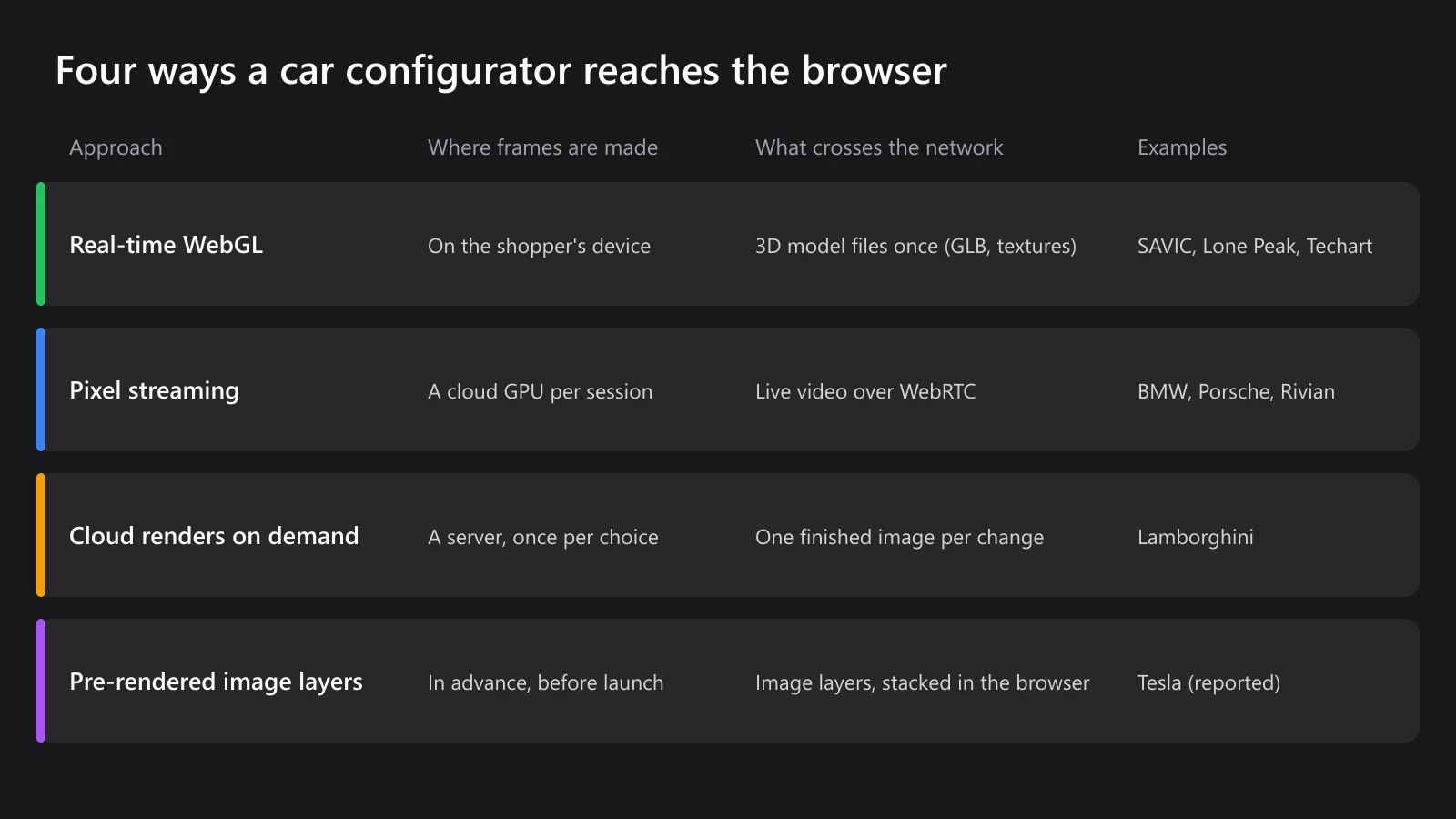
A car configurator reaches your browser in one of four ways: real-time WebGL rendered on your own device, a video stream from a cloud GPU, images rendered on demand in the cloud, or images composited from pre-made layers. BMW's EVE streams; Porsche, Lamborghini and Rivian pair server-rendered images with a streamed 3D mode; Tesla reportedly composites layers. Streaming buys photoreal quality at the highest running cost per shopper, while WebGL costs the least to run but leans on the shopper's phone.
- Real-time WebGL. The browser downloads 3D files, usually GLB compressed with Draco and KTX2, and renders every frame on the shopper's GPU with Three.js, Babylon.js or PlayCanvas.
- Pixel streaming. An Unreal Engine scene runs on a cloud GPU, and the browser plays a live video of it over WebRTC. Every click and drag travels back to the server (see listings).
- Cloud renders on demand. A server renders a still image of your exact configuration from a live 3D scene, then sends the picture.
- Layered images. Pre-rendered layers for paint, wheels and trim are stacked into one image, either in the browser or on a server.
In our catalog, motorcycle, camper and boat makers render real-time 3D, while most bicycle brands still send images. The sections below show the numbers.
How did we check what reaches the browser?
Our catalog labels each configurator by what the browser receives, because network traffic shows who pays for rendering. A streamed session holds a server GPU for its whole length, one GPU per user in BMW's setup (AWS). An image or a 3D file, by contrast, is paid for once and then cached.
We open each configurator in desktop Chrome with DevTools, then change paint, wheels and camera angle while watching for three kinds of traffic:
- WebRTC. A peer connection in
chrome://webrtc-internalswith a steady inbound video track means pixel streaming. - 3D files. Requests for
.glb,.gltf,.drcor.ktx2files at load, then no new requests while you rotate, mean real-time WebGL. - Images. A new
.jpg,.webpor.avifper option change means images. Several images stacked per view point to layers, and a slow first response for a new combination suggests on-demand rendering.
Mobile scores come from each listing's catalog review, which we run on a real phone, using the ten sub-scores in our methodology, each on a 1 to 5 scale.
On October 27, 2026, we rechecked eight carmaker configurators by reading the code each page loads, looking for WebRTC stream clients, 3D file loaders and image endpoints. Here is what we could confirm:
- BMW USA: server-rendered images from BMW's image service. No stream client in the Build Your Own code.
- Porsche Cayenne Electric (US): images on demand by default, plus a WebRTC client for a 3D view.
- Lamborghini: server-rendered images, plus a WebRTC stream client.
- Ferrari: each change sends the options and camera angles to a render service, which returns new image files.
- Lotus: one MHP-built app with both a WebRTC stream client and an image-on-demand path.
- Rivian: still images rendered in Unreal Engine, plus a ZeroLight OmniStream video mode.
- Lucid: pre-rendered images named by option code, and no stream client.
- Tesla: the site blocked our requests, so we couldn't check.
One caveat applies to everything below. A label describes one market's build on the day we scored it, and carmakers run different configurators per country and per model. Our BMW listing, for example, is the US Build Your Own tool.
Which approach do the big carmakers use?
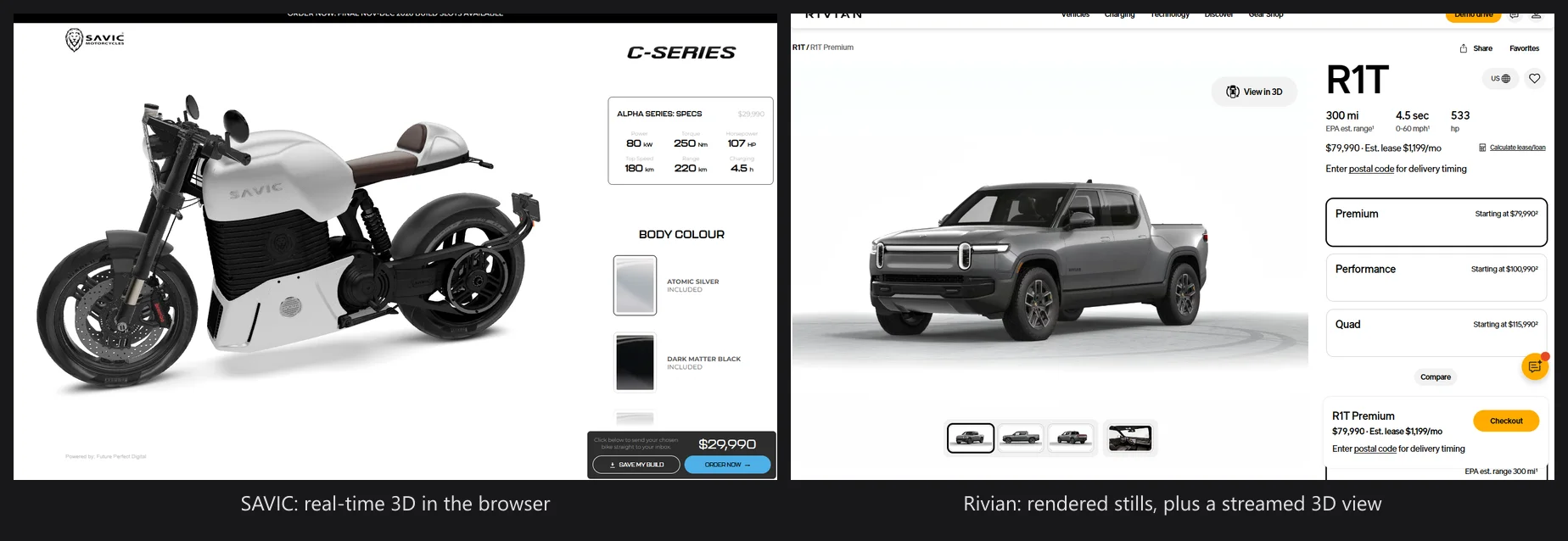
Premium carmakers mostly render on servers. BMW's EVE streams interactive 3D from cloud GPUs, Porsche, Lamborghini and Rivian pair server-rendered images with a streamed 3D mode, and Tesla reportedly composites images from option codes. The MHP platform behind Porsche's configurator also serves Aston Martin, Pagani, Ducati and Lotus (eCommerceNews, 2026).
| Brand | What reaches the browser | How it's built | Source |
|---|---|---|---|
| BMW (EVE, from September 2025) | Live video over WebRTC | Unreal Engine on AWS g4dn.2xlarge instances, one GPU per user from a pre-warmed pool | AWS |
| Porsche (Cayenne Electric, December 2025) | Images on demand, plus a streamed 3D view | MHP Elastic Content Platform and Porsche Rendering Solution, Unreal Engine on AWS | MHP |
| Audi (2018) | Live video stream | ZeroLight, rolled out in 25 markets | AWS Partner Network (vendor case) |
| Lucid (2021 teardown) | A pre-rendered 2D spin first, then streamed 3D | Upgrades after a roughly 25 MB bandwidth test, drops back after 60 s idle | skz.dev |
| Rivian | Unreal-rendered stills, plus a ZeroLight OmniStream video mode | R2 configurator "powered by Unreal Engine" (May 2026) | EV Wire |
| Lamborghini | Server-rendered stills, plus a WebRTC stream mode | Built with ZeroLight in 2019, now on the Volkswagen Group's Unreal-based visualization platform | ZeroLight, Epic Games |
| Tesla | Still images | Server-side compositor assembles images from option codes (reported by owners) | Cybertruck Owners Club |
Lucid's 2021 setup is the most useful one to study if your budget is smaller than a carmaker's. A developer teardown found it opened with a pre-rendered 2D spin, ran a roughly 25 MB bandwidth test, and only then upgraded to the stream; after 60 seconds idle it fell back to images (skz.dev, 2021). It was a hybrid built around the stream's two weak spots: a shaky connection and a GPU billed while nobody clicks.
Lucid has since simplified. On October 27, 2026, its configurator loaded only pre-rendered images named by option code, and we found no stream client.
Audi's figures are the best-known case for streaming. In a ZeroLight case study on the AWS Partner blog, Audi's streamed configurator drew 66% more engagement and 9% more options selected than its 2D version, with the stream reachable within five seconds (AWS, 2018). These are vendor figures from 2018, so read them as a ceiling, not a benchmark.
That pattern runs through the whole pixel streaming vs WebGL debate: most published comparisons come from streaming vendors. ZeroLight's own explainer, for example, argues for the cloud stream (ZeroLight). We haven't found one that compares load time and phone behavior across live configurators, which is the gap this article tries to fill.

Rivian's R1T/R1S builder carries our pixel streaming label, and our listing credits ZeroLight as the vendor. On October 27, 2026, the R1 builder's code loaded ZeroLight's OmniStream client for a streamed video view, next to still images rendered in Unreal Engine. Rivian software chief Wassym Bensaid said the R2 configurator is "powered by Unreal Engine" when it went live in May 2026 (EV Wire, 2026).
Pixel streaming vs WebGL: what does each approach cost you?
The biggest cost difference is where the GPU lives. Pixel streaming rents one cloud GPU per active shopper, which BMW draws from a pre-warmed pool of AWS g4dn.2xlarge instances (AWS). Real-time WebGL borrows the shopper's own GPU at no cost to you, but you pay up front to make the 3D files light enough for a phone.
| Real-time WebGL | Pixel streaming | Cloud renders on demand | Layered images | |
|---|---|---|---|---|
| What the browser receives | 3D files (GLB with Draco, KTX2) | Live video over WebRTC | One rendered image per view | Pre-rendered image layers |
| Where frames are rendered | Shopper's device | Cloud GPU | Cloud GPU | In advance |
| Running cost grows with | Bandwidth per visit | GPU time per concurrent session, plus the idle warm pool | Renders per new combination, cut by caching | Storage and bandwidth |
| Up-front cost sits in | Asset optimization: LODs, texture budgets, compression | Unreal scene, session orchestration, capacity planning | Production 3D scene and render pipeline | Rendering every layer at every angle |
| Wait before first view | Model download, set by file size | Session start (Audi: within five seconds) | First render | Image download |
| Delay per interaction | None after load | Network round trip on every drag | A new render per change | A new image per change, often cached |
| On a phone | Depends on the phone's GPU and memory | Light on the device, heavy on the connection | Light | Lightest |
| On a weak connection | Works once loaded | Needs a fallback (Lucid's 2021 build dropped to a 2D spin) | Slower images | Degrades gracefully |
| Camera freedom | Full | Full | Fixed angles or spins | Fixed angles |
| Examples | SAVIC, Lone Peak, Indian Motorcycle | BMW EVE, Porsche, Audi, Rivian | Lamborghini | Tesla (reported) |
At AWS's on-demand rate of $0.752 an hour for a g4dn.2xlarge in US East on October 27, 2026 (AWS), one GPU held for a 10-minute session costs about 13 cents, before bandwidth and idle pool time.
Pixel streaming: you pay for every minute of attention
Streaming cost scales with how long people stay, not with how many files they download. Every concurrent shopper holds a GPU, and BMW keeps a pre-warmed pool so new sessions start without waiting for a server to boot (AWS). A pool sized for launch-day peaks, which reached 500 parallel sessions at BMW, means paying for idle GPUs as well as busy ones.
Latency is the second cost. Each drag of the camera goes to the data center and comes back as video, so the experience depends on the shopper's distance from the server and the quality of their connection. Lucid's 2021 bandwidth test and idle timeout were built to manage exactly those two limits.
On a phone, streaming is light on the device and heavy on the connection. The phone only decodes video, but a train tunnel or a crowded café network shows up as blur or a frozen frame. Without an image fallback, that shopper sees nothing useful.
Cloud renders and layered images: you pay per picture
Image approaches move the cost from session minutes to pictures. Lamborghini serves server-rendered stills (ZeroLight), so a new combination costs one render, and a cache can serve it again. The shopper gets photoreal stills on any phone but gives up a free camera unless they switch to the streamed mode.
Layered images push almost all of the cost into production. Tesla's configurator reportedly assembles each picture on a server from option codes (Cybertruck Owners Club), which keeps the browser's job tiny. The price is paid in advance, because every layer has to exist at every angle you want to show.
This is still the most common setup across configurators in general. In a 2021 study of the 97 most popular entries in cyLEDGE's Configurator Database, 73.2% showed the product as flat 2D or layered images, and 22.7% allowed 360-degree rotation (MCP-CE, 2022).
Real-time WebGL: you pay up front, then the phone does the work
WebGL flips the cost curve. Once the GLB files sit on a CDN, each extra shopper costs bandwidth rather than GPU time, because every frame renders on their own device. After load, interactions run at the device's frame rate, with no server round trip.
The bill arrives earlier, as asset work. A vehicle model has to be cut down with LODs, compressed with Draco and KTX2, and kept inside a texture budget that a mid-range phone can hold. Skip that step and you pay in load time, which costs sales: a Deloitte study commissioned by Google found a 0.1 s faster mobile site lifted retail conversion by 8.4% and order value by 9.2% across 37 brands (web.dev).
We cover budgets in what a 3D product configurator costs in 2026 and phone performance across industries in the mobile gap report.
What do the automotive listings in our catalog show?
Of the 23 automotive configurators we track, 13 render real-time 3D in the browser, 11 send images, 2 mix both and 2 streams video. Automotive also accounts for 11 of the 28 image-based listings across all 140 apps in the catalog.
Counts in this section update from the live catalog; the analysis was written against our October 22, 2026 snapshot. Here is how the split looks by vehicle type:
| Vehicle type | Listings | Real-time 3D | 2D images |
|---|---|---|---|
| Cars | 14 | 7 | 7 |
| Bicycles | 5 | 2 | 4 |
| Motorcycles | 2 | 2 | 0 |
| Campers and vans | 2 | 2 | 0 |
| Boats and yachts | 1 | 1 | 0 |
Some listings carry two vehicle types, so rows can overlap. Hybrid and streamed listings sit outside the last two columns.
Inside the car row, the split tracks who makes the configurator. At our October 22 snapshot, Ferrari, Lamborghini, BMW, Maserati, Lotus and Rivian all sent images or video; the only carmaker builds rendering 3D in the browser were TOTEM's hybrid and a Gazoo Racing configurator on Blend4Web. Most other real-time 3D "car" listings come from tuners, suppliers and demos, such as Techart's Porsche configurator and BASF's paint showcase.
Why BMW, Lamborghini and Ferrari carry a 2D label
Our rendering label records what reaches the browser, not how the pixels were made. If the browser receives images, the listing is 2D, even when a server rendered those images from a full 3D scene a moment earlier. Lamborghini is the clearest case: its default view shows stills rendered on a server (ZeroLight), and the browser only receives the finished images.
BMW is the one to watch. BMW has streamed Unreal Engine over WebRTC since the iX3 launch in September 2025 (AWS), yet our BMW USA listing still carries the 2D label from the build we scored. On October 27, 2026, the US Build Your Own pages loaded images from BMW's image service, and we found no stream client in their code.
Ferrari's configurator also sends images to the browser. On October 27, 2026, its code sent each new set of options and camera angles to a Ferrari render service, which returned newly rendered image files.
Our Lotus listing shows the reverse tension: it's tagged with Unreal Engine pixel streaming but labeled 2D. Its MHP-built configurator holds both paths in one app, a WebRTC stream client that reserves a free cloud server and an image-on-demand path.
For a buyer, the lesson is practical. When a vendor promises "real 3D," ask what travels over the wire to the shopper's phone, because that decides your running cost and your mobile experience.
Images still win on phones, for now
At the time of writing, image-based automotive listings score higher on phones. They average 4.01 on mobile and 4.18 on initial load feel, against 3.27 and 3.73 for real-time 3D listings. Real-time 3D leads where you'd expect, on interactivity: 3.54 against 3.32.
Two caveats keep this honest. The groups are small, and the 3D group includes builds such as a Blend4Web configurator and a Sketchfab-hosted yacht builder that pull its phone average down. The Three.js and PlayCanvas builds from SAVIC, Lone Peak and Indian Motorcycle hold up well on phones in our scoring.
For context, mobile averages 3.55 across the whole catalog and 3.63 in automotive. It's the weakest of our ten sub-scores at the time of writing, which is why we gave it its own report.
What car configurators do that other categories don't
Rendering is half the build; the other half is rules and direction. In our automotive listings, 52% use conditional logic, 65% show a running price and 39% use guided camera paths, against 4% of furniture configurators for camera paths. Car buyers expect the camera to fly to the wheels or the cabin, and they expect the build to block impossible combinations.
That second expectation is where carmakers still stumble. Simon-Kucher's 46-brand study found that equipment dependencies still frustrate users, even as it ranked Mercedes first, BMW second and Audi third (Simon-Kucher, 2023). Goodwood's 2020 roundup put the golden rule more simply: show the price (Goodwood, 2020).
For the same comparison across furniture, fashion, jewelry and home, see how five industries use browser 3D.
Why do motorcycle and camper brands choose real-time 3D?
At our October 22 snapshot, every motorcycle, camper and boat configurator in the catalog rendered real-time 3D in the browser, mostly on Three.js. These brands also sell differently: Cox Automotive found only 7% of car buyers bought entirely online, and 63% called a mix of online and dealer steps ideal (Cox Automotive, 2025). Yet at the same snapshot, every automotive listing with cart checkout was a bike, a motorcycle or a camper.
In our experience, the economics explain the choice. A small brand rarely has the steady traffic that justifies a GPU pool, and a motorcycle or camper usually has fewer parts and options than a car, so the 3D files can stay light. One well-built model also covers every angle and every option, where an image set multiplies with each new choice.

SAVIC Motorbike 3D Configurator
 SAVIC Motorcycles

Lone Peak Truck Camper Bed 3D Configurator
 Lone Peak Overland

Campsuha Van 3D Configurator
Campsuha

Techart Porsche 3D Configurator
 Techart
SAVIC's motorbike configurator uses guided camera paths and cinematic transitions to move between parts, and it prices the build as you go. It's the same directed experience carmakers stream from a GPU, rendered on the shopper's own device.
Lone Peak's truck camper configurator handles modular parts, conditional rules and animated sequences, then ends in a cart. For a camper, seeing how the modules fit together in 3D answers questions a photo set can't.
Campsuha's van builder takes the quote-led route. Animation and camera moves walk you through the layout, and the finished build goes to the sales team as a lead.
Techart's Porsche configurator shows the tuner's version: a Sketchfab-hosted model with conditional rules and CPQ, strong on clarity and interactivity in our review. Sketchfab changed hands in August 2026, when Epic sold it to KitBash (Epic Games, 2026), so check the hosting platform's roadmap before you build on it.

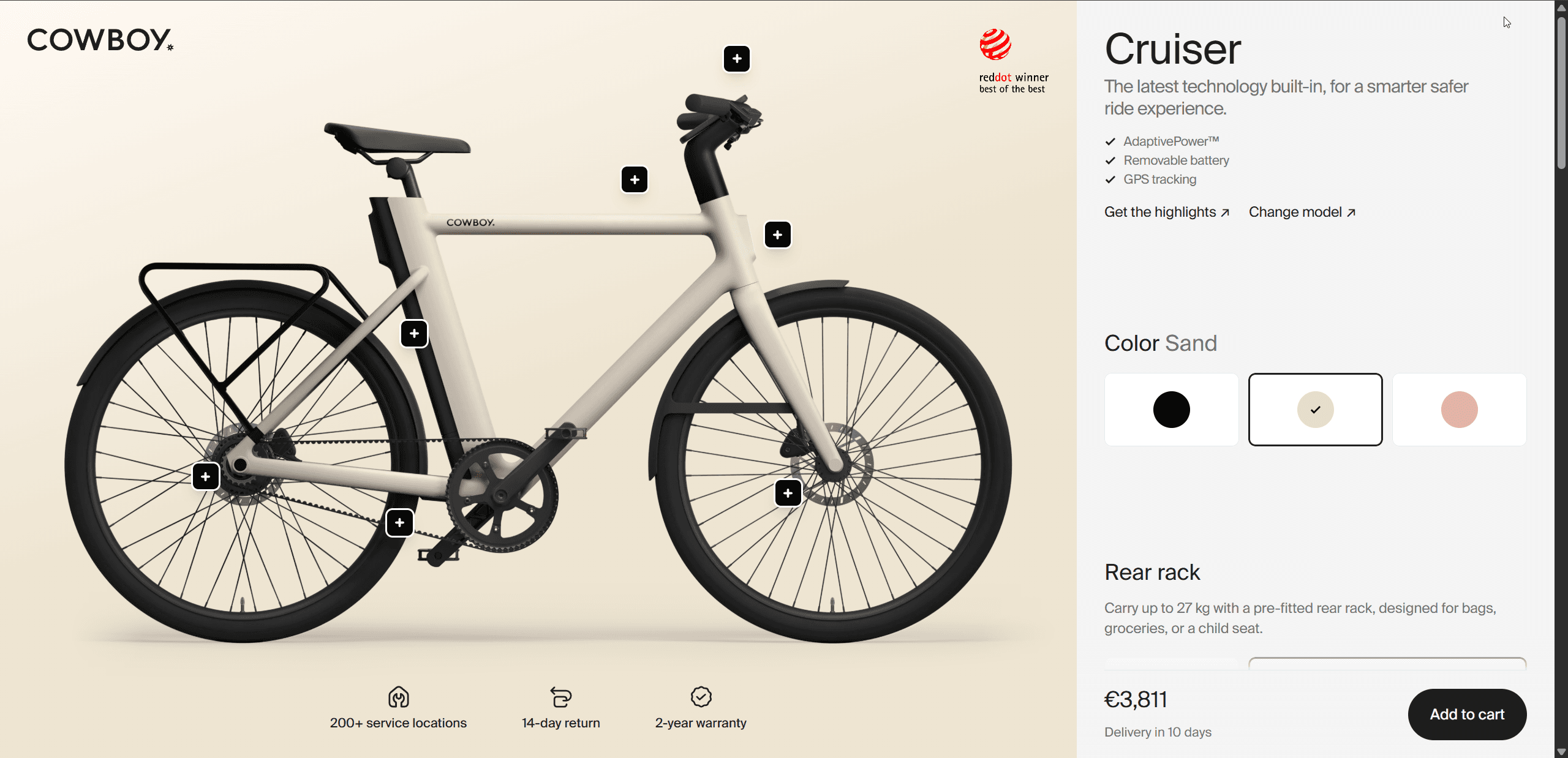
Real-time isn't automatically the better call, and bicycles prove it. Cowboy's e-bike configurator is the top-scored automotive listing in our catalog at the time of writing, and it sends pre-rendered images that load fast and score at the top of our mobile scale. Bicycle brands lean the same way: 4 of the 5 bicycle listings we track send images.
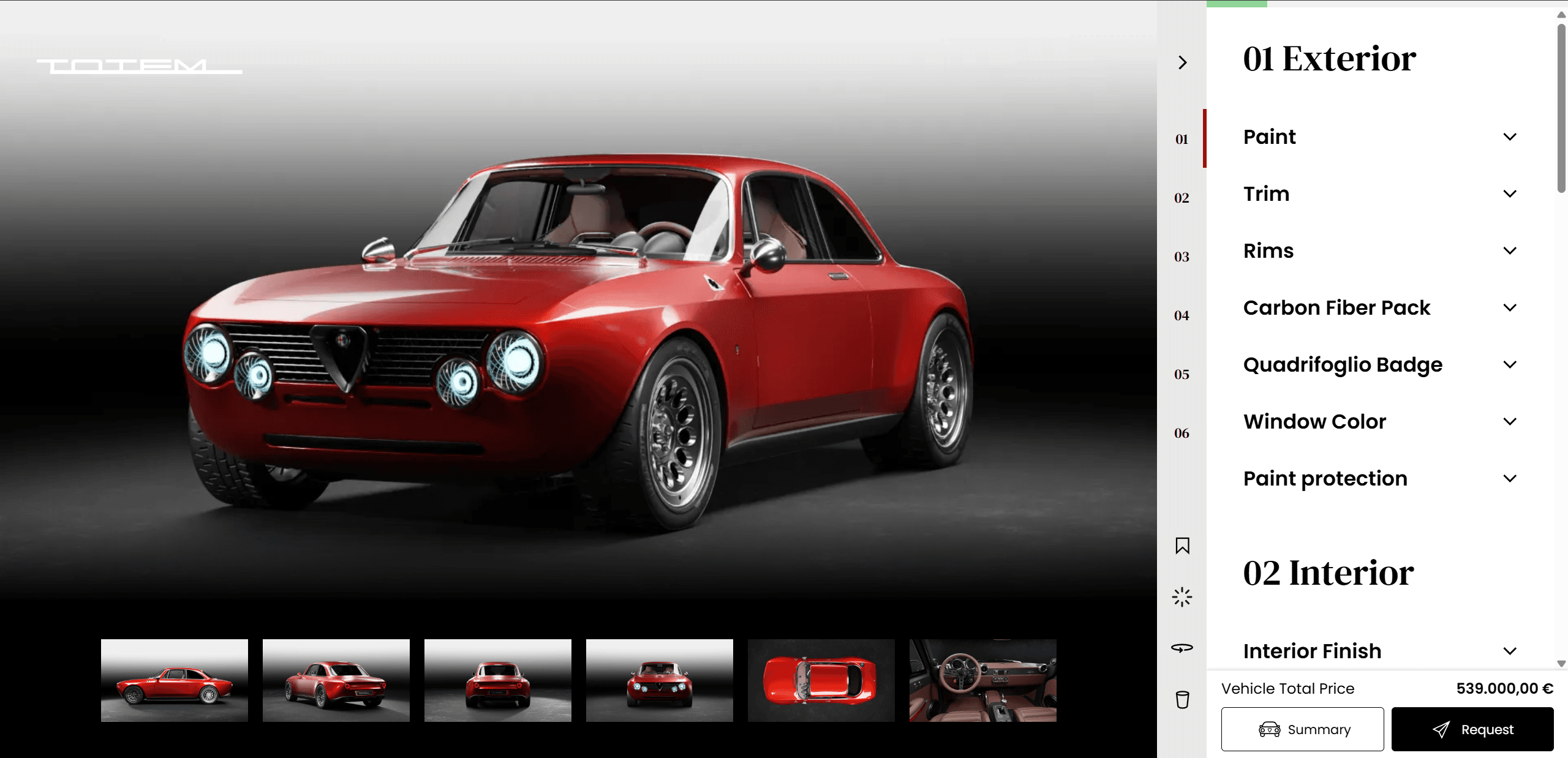
TOTEM's configurator splits the difference with a hybrid of Three.js 3D and 2D views. It's close in spirit to Lucid's 2021 mix of images and live 3D, at a fraction of the infrastructure.
Cowboy Electric Bike 2D Configurator
 Cowboy
TOTEM Car Configurator
 TOTEM
Frequently asked questions
Is pixel streaming better than WebGL for a car configurator?
Neither wins in general. Pixel streaming delivers photoreal Unreal Engine quality on any device but needs a cloud GPU per shopper, as BMW's EVE does on AWS (AWS). A real-time car configurator in WebGL costs far less to run and keeps working once loaded, but needs optimized assets to perform on phones.
Why are car configurators so slow?
Usually because a heavy asset or a server session has to arrive before you can do anything. Streams must start a GPU session and test your connection (Lucid's 2021 build downloaded roughly 25 MB, per a teardown), while WebGL builds download large models. Speed pays: a 0.1 s mobile gain lifted retail conversion 8.4% in a Google-commissioned Deloitte study (web.dev).
What are the best car configurators in 2026?
Most "best car configurators" lists still date from 2020 (Goodwood, 2020). In our catalog, the top-scored automotive listings at the time of writing include Cowboy, Ferrari, Lamborghini Ad Personam and Techart's Porsche build, a mix of images and real-time 3D. Browse live scores across all 23 in our automotive section or the top 10 across industries.
Does a 2D label mean the configurator has no 3D?
No, our label records what reaches the browser. Lamborghini's default view shows stills rendered on a server (ZeroLight), so the listing is 2D. The label predicts load and phone behavior; the vendor's pipeline predicts image quality.
Choosing for your product
Start from your traffic, your product and your shoppers' phones, not from the demo. Most shoppers will meet your configurator on a phone: Wayfair, for one, took 64.9% of its Q4 2025 orders on mobile (Wayfair, 2026). A stream that impressed you on office fiber has to work there too.
- Choose real-time WebGL if buyers need to see the product from any angle or opened up, and your part count is manageable. Budget for asset optimization (GLB, Draco, KTX2, LODs) and test on a mid-range phone before launch. SAVIC and Lone Peak show the result.
- Choose pixel streaming if photoreal detail is part of what you sell and your 3D already lives in Unreal Engine. Price the GPU hours per session before you sign, and plan an image fallback for weak connections, as Lucid did.
- Choose cloud renders on demand if you need photoreal stills across a huge option space but can live without a free camera, as Lamborghini does.
- Choose pre-rendered or layered images if your options are mostly visual swaps on a few angles and load speed matters most. Cowboy shows how far a well-shot image set can go.
- Combine them when one approach can't cover every shopper: a fast image view first, with 3D or a stream for those who want more. Rivian and TOTEM do this in different ways.
Whatever you choose, put the same four questions to every vendor:
- What does the browser receive: files, video or images?
- What does one concurrent session cost to run, and how does that change at ten times the traffic?
- What does a shopper on a weak mobile connection see?
- Which mid-range phone did you test on, and how long did the first view take?
The furniture version of this decision, with five brands on five platforms, is in Herman Miller, Steelcase, Vitra, USM and Joybird compared. If you already have a product and a rough brief, you can also request a build and get a recommendation on the approach.