3D Product Configurators by Industry: 12 Features Compared

You've just tried a competitor's 3D configurator, or built a sneaker on Nike By You, and now someone on your team is asking whether you need one too. The harder question comes right after: if you build one, what should it actually do?
Most first-time buyers answer by copying the most impressive configurator they've seen. That's usually a car or a shoe, and it's often the wrong model for a sofa, a ring or a garden room.
We track 150 live browser 3D configurators and viewers and score each one on performance and UX (how we score). For this post we compared 12 features across the five industries that make up most of the catalog, to see what each one actually builds.
The short answer
Each industry has a lead feature, and it's rarely the one that looks best in a demo. Furniture configurators sell dimensions and modularity, automotive sells camera direction and option rules, and fashion sells personalization. Watches and jewelry sell materials, often without a cart, so copy the leaders in your own industry rather than the prettiest neighbor.
Key Takeaways
- Material and color switching appears almost everywhere, so it won't set you apart.
- 46% of furniture configurators draw measurements on the model, more than any other industry.
- Automotive leads on guided cameras and option rules; fashion leads on engraving.
- Many watch and jewelry configurators have no cart at all.
- Mobile is the lowest-scored sub-score across the catalog.
What is a 3D product configurator?
A 3D product configurator is a web page where shoppers change a product's materials, parts or size and watch a model update with each choice, usually with a live price. In our catalog, 83% of live listings render that model in real time in the browser; the rest send 2D images, a 2D and 3D mix, a video stream or AR.
Real-time 3D means the shopper's own phone or laptop draws the product, usually through Three.js, Babylon.js or PlayCanvas on top of WebGL. The model ships as a compressed GLB file, often with Draco geometry and KTX2 textures, so file weight decides how the first seconds feel. Pixel streaming flips this: a GPU server runs Unreal Engine and streams video to the browser over WebRTC.
A configurator isn't the same as a 3D viewer. A viewer lets you spin and zoom one fixed product, while a configurator lets you change it and prices the result.
3D is still the exception in the wider configurator market. In a 2021 study of the 97 most popular entries in the Configurator Database, 73.2% showed products as flat 2D or layered images and only 22.7% allowed 360° rotation (cyLEDGE, MCP-CE 2022).
The business case is real but thinner than vendor decks suggest. Google's own shopping data showed that people engage almost 50% more with 3D images than with static ones (TechCrunch, 2022). The often-quoted "94% higher conversion with 3D" has no published source behind it (Shopify), so we don't rely on it.
If you'd rather see strong work before reading on, start with our 3D product configurator examples, the 10 best-scored live configurators across industries.
3D product configurator features by industry: the heatmap
Material and color switching is close to universal, from 90% of watch and jewelry configurators to 96% of furniture ones, so it can't tell you what to build. The useful rows are the ones where industries split: measurement, engraving, guided cameras and option rules.
Each cell below is the share of that industry's live listings with the feature, computed from the catalog when this page loads. The populations are 28 furniture, 25 automotive, 21 fashion and accessories, 21 watch and jewelry, and 20 home and garden listings. Features come from our own tagging of each listing (methodology), and the analysis in this post was written against the 22 October 2026 snapshot.
| Feature | Furniture | Automotive | Fashion | Watches & jewelry | Home & garden |
|---|---|---|---|---|---|
| Material and color switching | 96% | 92% | 95% | 90% | 100% |
| Modular assembly | 86% | 52% | 43% | 38% | 70% |
| Price calculation | 75% | 64% | 52% | 67% | 45% |
| Conditional logic | 39% | 48% | 24% | 14% | 40% |
| Save and load | 54% | 40% | 14% | 24% | 50% |
| Share configuration | 43% | 40% | 38% | 24% | 40% |
| Measurement overlay | 46% | 0% | 0% | 0% | 30% |
| Custom text and engraving | 0% | 4% | 57% | 33% | 0% |
| Guided camera paths | 4% | 36% | 24% | 14% | 10% |
| Quote PDF export | 18% | 4% | 10% | 10% | 25% |
| Snapshot export | 36% | 24% | 19% | 10% | 35% |
| AR viewer | 14% | 4% | 0% | 0% | 15% |
Read the table by row, not by column. The top row only tells you that a configurator without material switching isn't really a configurator; the rows below it are where your brief should start.
Measurement overlay reaches 46% in furniture and 0% in automotive. Custom text and engraving reaches 57% in fashion and 0% in furniture. Guided camera paths reach 36% in automotive against 4% in furniture.
AR is rarer than its press coverage implies. Even in home and garden, where placing a product in your own space seems most useful, only 15% of listings offer an AR viewer.
Furniture: dimensions and modularity
Furniture shoppers need to know a piece will fit before they care about the fabric. In our catalog, 86% of furniture configurators support modular assembly and 46% draw measurements on the model, the highest measurement share of any industry we compared.
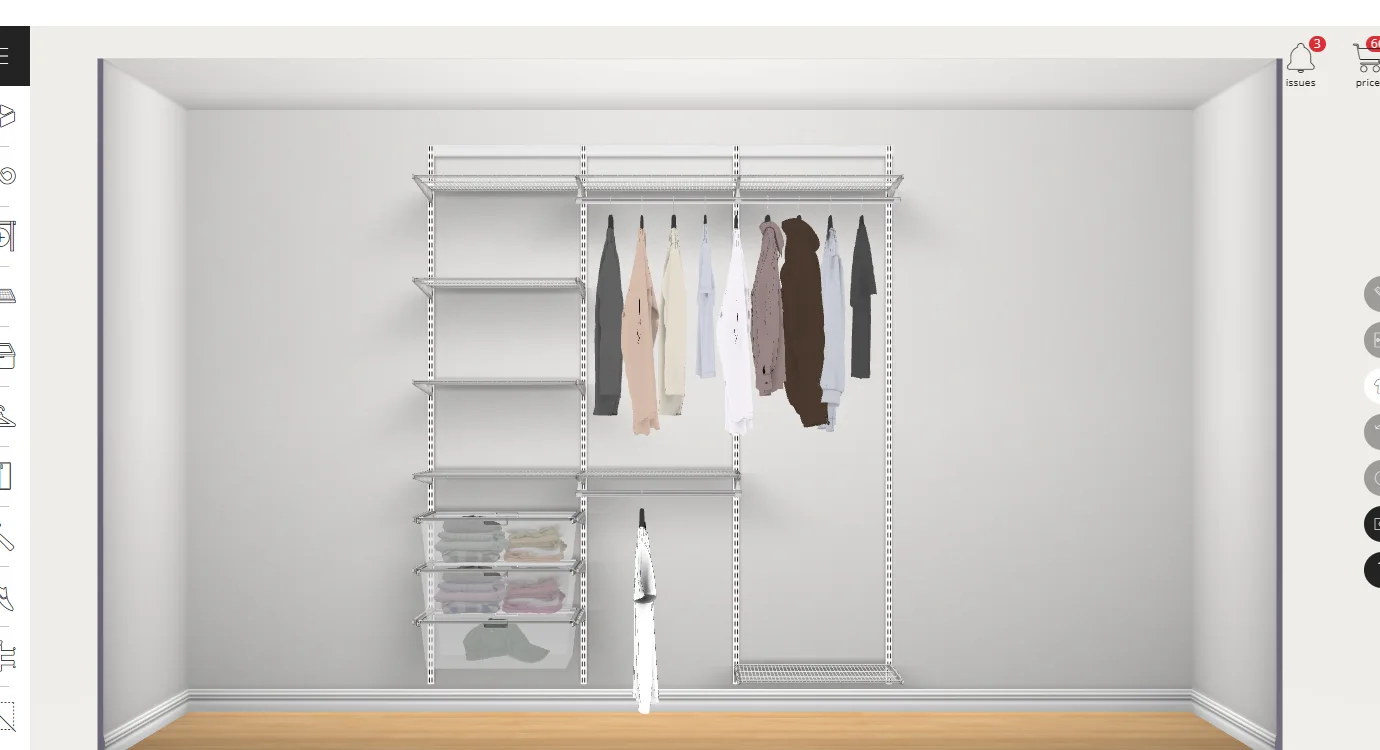
The leaders treat dimensions as the product. Elfa's planner builds a storage wall section by section with measurements on screen and ends in a priced bill of materials, while Tylko, built on Three.js, lets shoppers resize shelving with parametric controls and watch the price update.
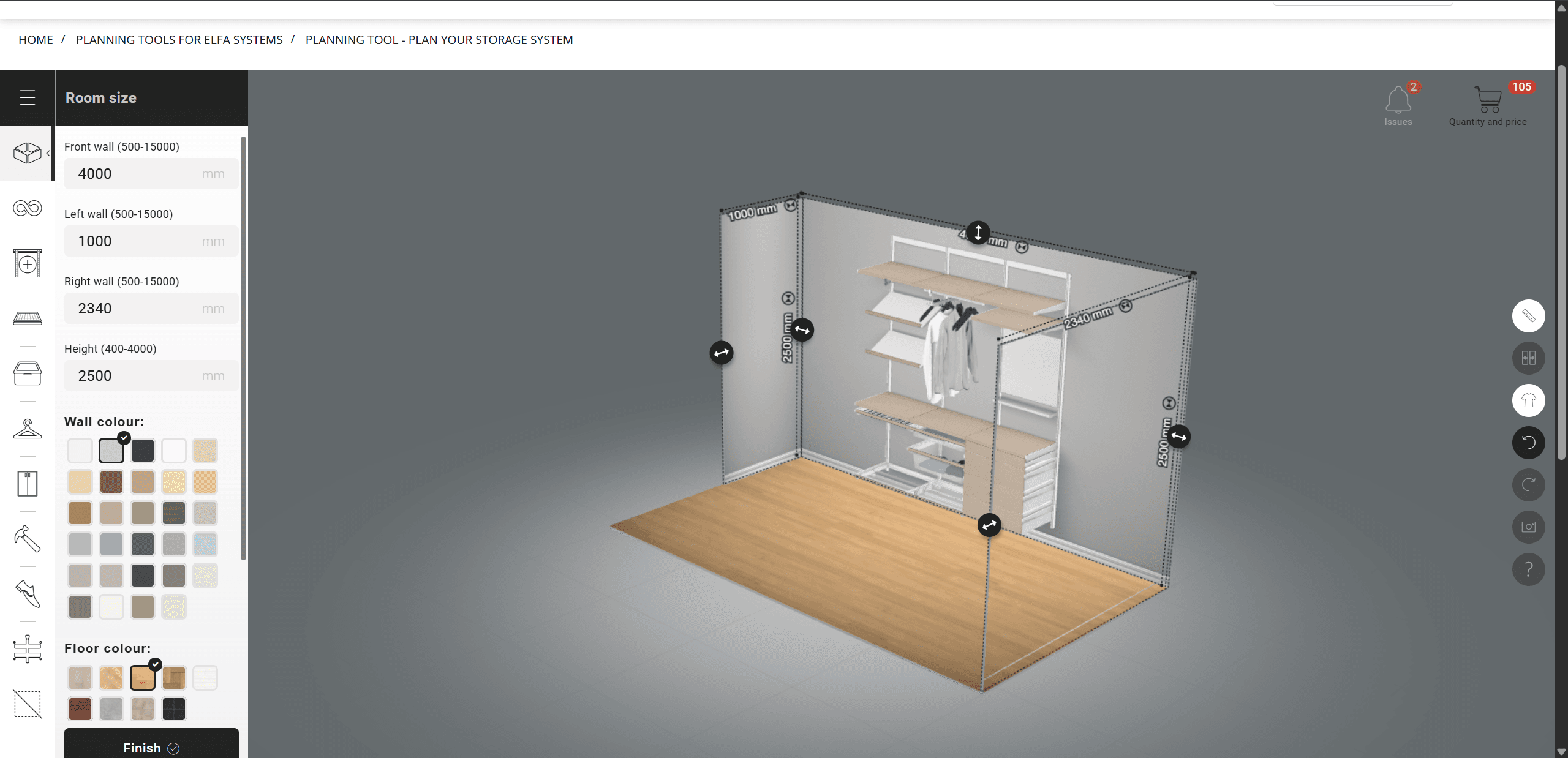
Elfa Storage System 3D Planning Tool
 Elfa
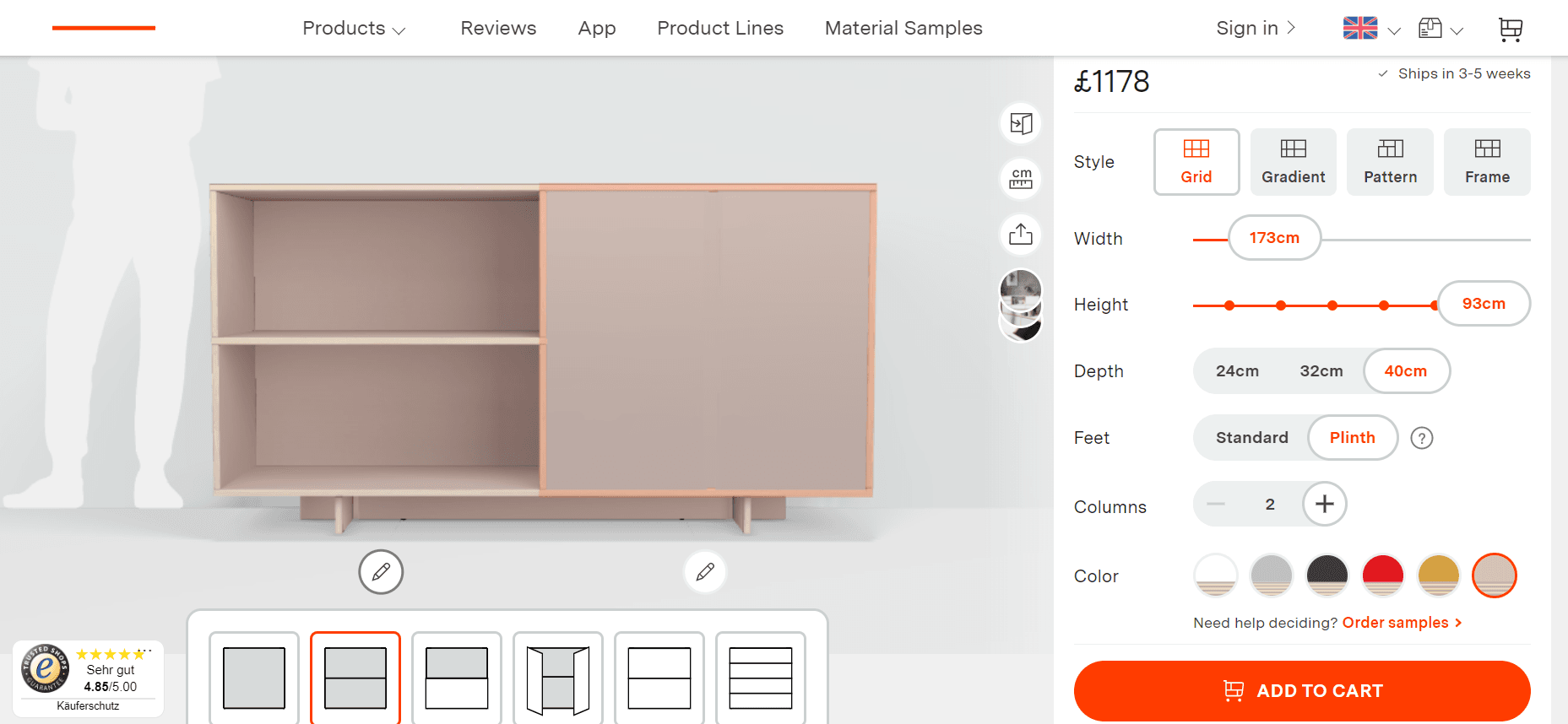
Tylko 3D eCommerce Website
 Tylko
Accurate size matters after the sale, too. An EMAC 2025 paper found AR reduces returns only when it shows size accurately, and that inaccurate sizing inflates expectations (EMAC 2025). With NRF and Happy Returns estimating US online returns at 19.3% of sales for 2025 (NRF), dimensions on the model are cheap insurance against returns.
Furniture also builds almost entirely in real time: 96% of listings render 3D in the browser, and Three.js powers 14 of them. The furniture configurator benchmark breaks down what the top 10 share, and Herman Miller, Steelcase, Vitra and USM compared shows how big brands chose their platforms. Browse every listing in furniture and workspaces.
Automotive: camera direction and option rules
Vehicle buyers already know roughly what the product looks like, so they want to see their version from the right angles and trust that the options work together. It shows in the data: 36% of automotive configurators in our catalog use guided camera paths and 48% enforce conditional option rules, the highest shares for both features among the five industries.
Option rules are where car configurators still trip people up. Simon-Kucher's 2023 study of 46 brands, which ranked Mercedes, BMW and Audi first to third, found that equipment dependencies still frustrate users (Simon-Kucher). If one wheel only works with one brake package, your configurator has to explain why, not just gray the option out.
Big carmakers often direct the camera from a server instead of the browser. BMW's EVE configurator streams Unreal Engine from AWS GPUs over WebRTC, one GPU per user (AWS, 2026), while Lamborghini renders 2D images on demand from a live 3D scene in the cloud (Lamborghini). A vendor-produced ZeroLight case study credits Audi's streamed configurator with 66% more engagement and 9% more options selected than its 2D version (AWS Partner Network, 2018).

SAVIC Motorbike 3D Configurator
 SAVIC Motorcycles

Ferrari Car 2D Configurators
 Ferrari
Our catalog records what reaches the browser, so Lamborghini and Ferrari are labeled 2D even where the images come from 3D scenes on servers. That puts 48% of automotive listings in 2D, the highest share of the five industries, while smaller vehicle brands such as SAVIC run real-time Three.js with scripted camera moves. How car configurators actually render compares the approaches, and the automotive industry page covers everything from cars to e-bikes and campers.
Fashion and footwear: personalization
Fashion shoppers configure to make something theirs, so the lead feature is a name, initials or a custom mark. In our fashion and accessories category, which spans shoes, bags, eyewear and apparel, 57% of configurators offer custom text or engraving, against 33% in watches and jewelry and 0% in furniture.
Nike By You is the usual reference point: colors per panel, personal text and a straight path to checkout, rendered with Babylon.js. Rimowa applies the same idea to luggage, with custom lettering and a live price in Three.js.
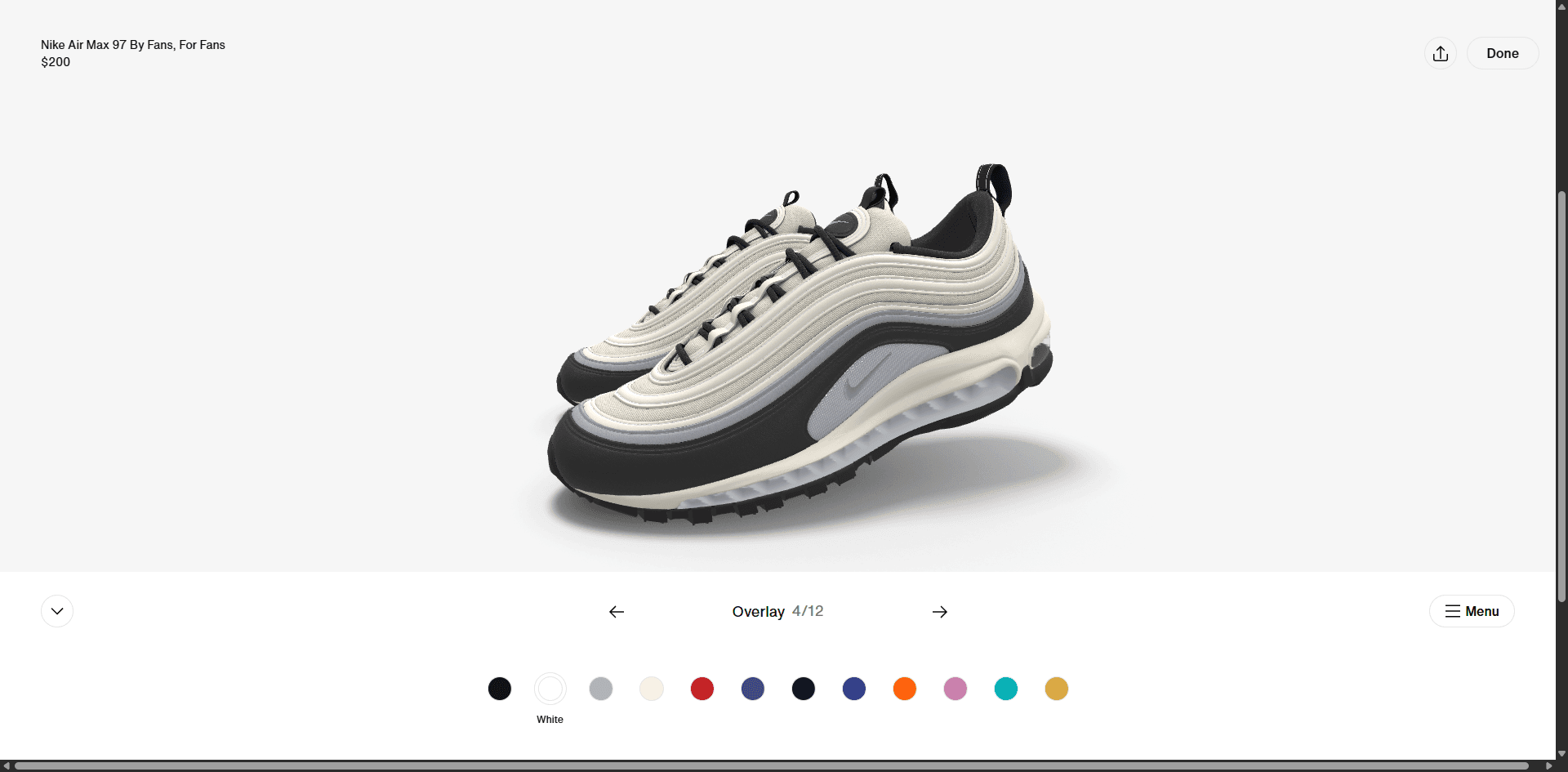
Nike By You 3D Shoes Configurators
Nike
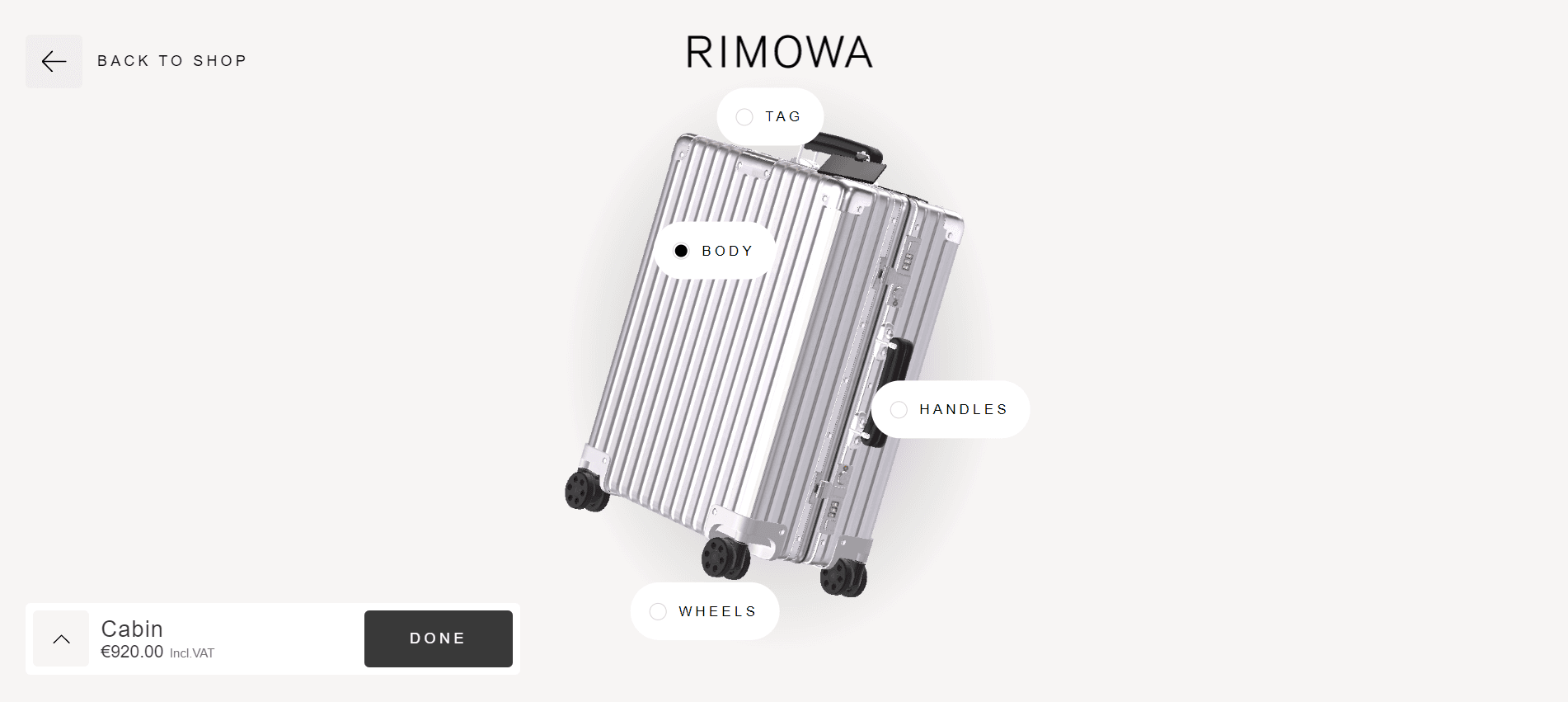
Rimowa Suitcase 3D Configurator
 Rimowa
Even plain 3D viewing can move fashion buyers. Shopify's own case study on Rebecca Minkoff reports a 44% lift in add-to-cart and a 27% lift in orders when shoppers interacted with 3D (Shopify), though that's one brand measured on the platform's own data.
The weak spot is the phone. The category's mobile average is 3.48 against 3.55 for the whole catalog, and 4 fashion listings score below 3 on mobile, the most of the five industries at the time of writing. See all fashion and accessories configurators or filter by custom text and engraving.
Watches and jewelry: materials, often without a cart
Watch and jewelry configurators sell the look of metal, stone and strap, and many never ask for payment. In our catalog, 90% offer material and color switching, yet 43% have no commerce at all, the highest share of the five industries.
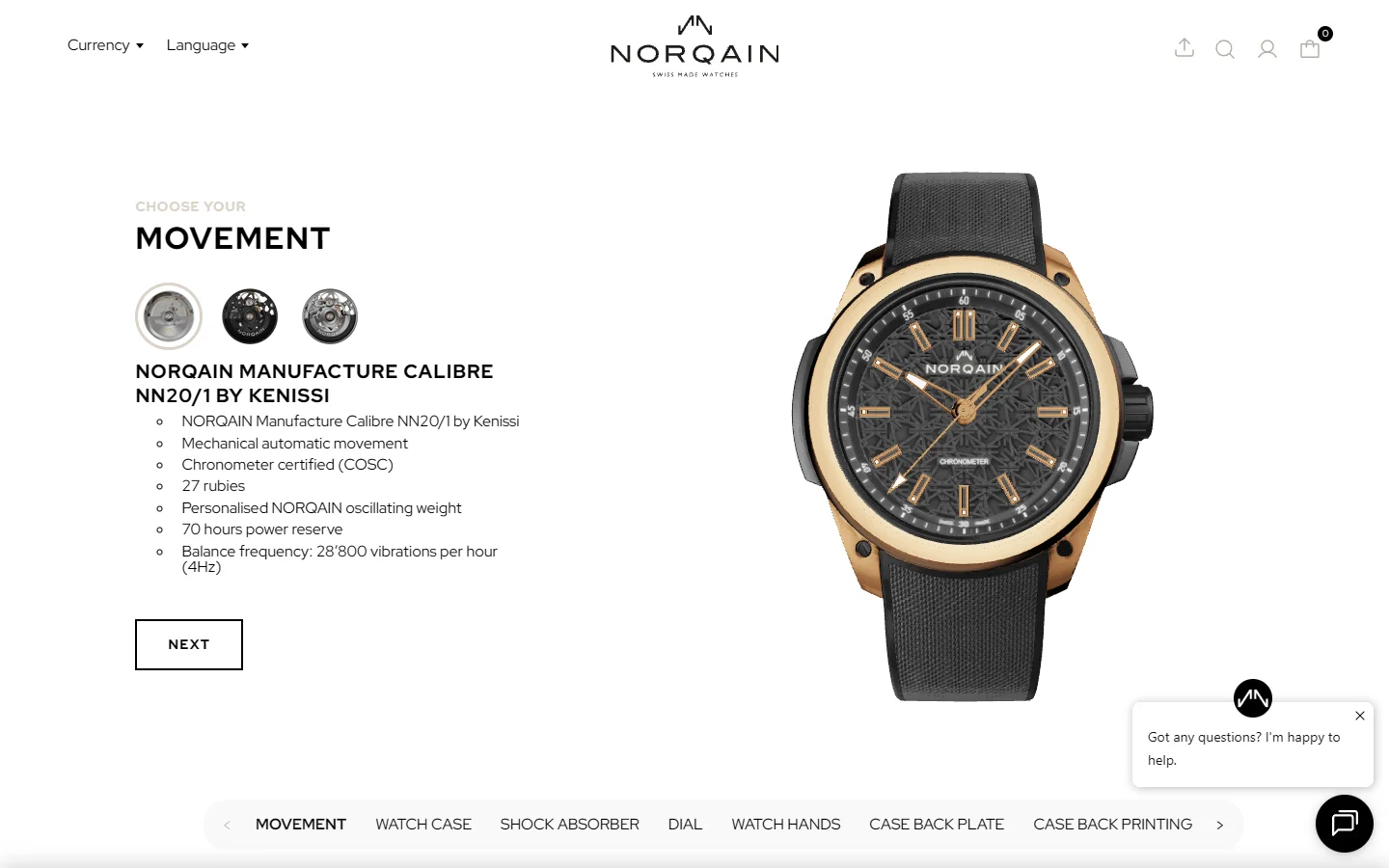
Rolex shows the showroom model. You combine materials, dials and bracelets, save the result, and see it in 2D images with no cart. NORQAIN takes the opposite route, with a PlayCanvas configurator, engraving, a step-by-step flow and checkout at the end.

NORQAIN Watch Configurator
 NORQAIN

Rolex 2D Watches Configurator
Rolex
Materials are the hard part technically, because polished metal and cut stones need convincing reflections and refraction. That's likely why this category experiments with heavier rendering: 2 of the 4 pixel-streaming listings in our catalog are in watches and jewelry, including Swarovski's Unreal Engine proof of concept.
If you sell through retailers or by appointment, a configurator without a cart is a legitimate choice, not a gap. Its job is to send the shopper to the boutique already sure about the dial. Browse watches and jewelry or the no-commerce listings across industries.
Home and garden: fit on a real plot
Garden rooms, patio roofs, pools and doors have to fit a real house or plot, so home and garden configurators combine modules with site context. In our catalog, 70% support modular assembly and 50% let shoppers save a design for later, matching furniture for the highest save rate at the time of writing.
Samara places its backyard unit in a scene and prices it as you build. Garden Room Planner goes further on fit: you draw the room to size, export a 2D plan and preview it in AR.
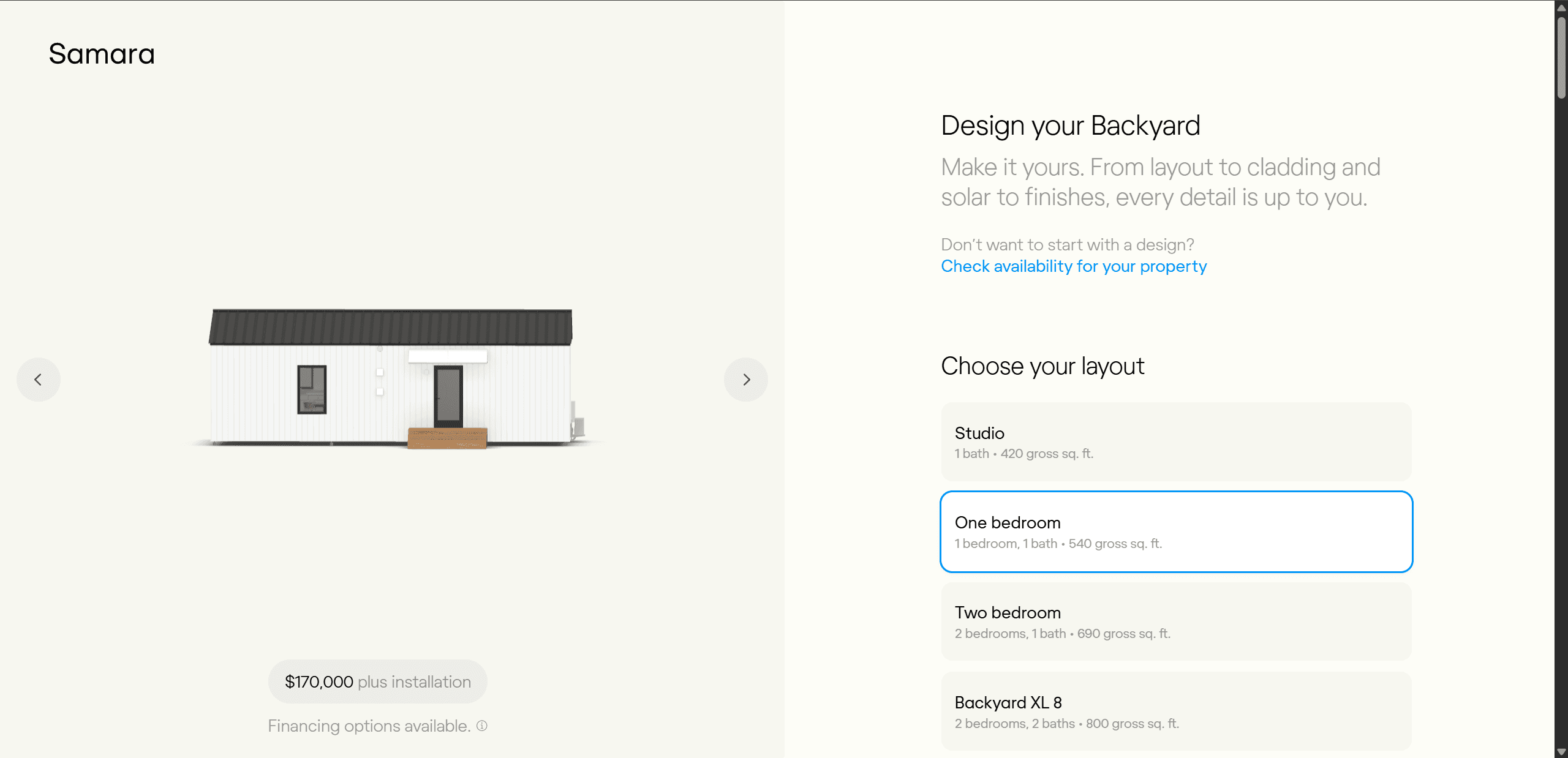
Samara Backyard Hybrid 3D&2D Configurator
Samara
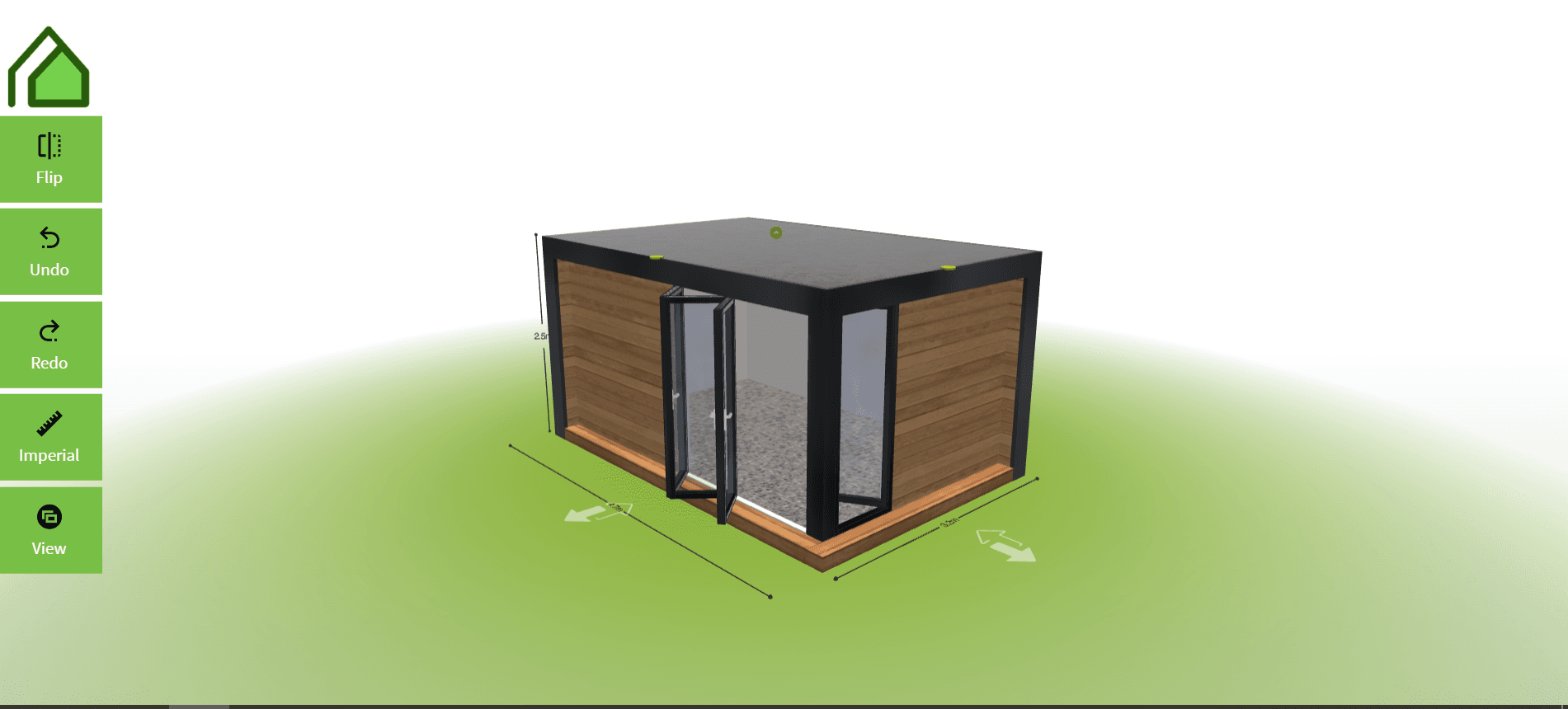
Garden Room 3D Planner
 Garden Room Planner
IKEA Kreativ shows where room context is heading: shoppers scan a real room, erase their own furniture and place IKEA items, using technology from Geomagical Labs, which IKEA acquired in 2020 (CXM Today). For most home and garden brands the practical win is simpler, since 25% of listings export a quote PDF that a sales rep can follow up on.
These are installed, considered purchases, so quotes and CPQ do most of the selling, as the next section shows. Browse all home and garden configurators or the environment context filter.
How does each industry close the sale?
The checkout model follows the product, not the technology. At the time of writing, fashion sends 62% of its configurators straight to a cart, automotive leads on CPQ at 28%, and home and garden leans on quotes at 45%. Watches and jewelry stand out the other way, with 43% selling nothing on the page.
| Commerce model | Furniture | Automotive | Fashion | Watches & jewelry | Home & garden |
|---|---|---|---|---|---|
| Cart and checkout | 54% | 28% | 62% | 38% | 15% |
| Quote or lead | 32% | 28% | 14% | 19% | 45% |
| CPQ | 7% | 28% | 0% | 0% | 20% |
| No commerce | 7% | 16% | 24% | 43% | 20% |
Shares are of each industry's live listings and may not add up to 100% because of rounding.
A cart works when every configuration maps to a fixed price and a ship date. Vitra's Eames Plastic Chair configurator, embedded from Emersya, updates price and delivery time from the ERP with each choice (Emersya), which is what makes direct checkout safe.
Quote and lead flows fit products that need a dealer, a site visit or a sales call. USM's Haller planner, built with EasternGraphics, the company behind pCon, shows a live price. It also exports DWG, SKP and FBX files and passes the design to a USM sales partner (USM), because office fit-outs close through people.
CPQ, short for configure, price, quote, sits in between: the configurator produces a priced, rule-checked order that goes to sales. That's the car pattern, and it matches buyer behavior: only 7% of car buyers in Cox Automotive's 2025 study bought entirely online, while 63% said a mix of online and in-person is ideal (Cox Automotive).
Pick your column before you pick a 3D approach. The commerce model drives the integration work, which is one of the biggest cost lines alongside 3D assets and rule logic, as our configurator cost breakdown explains.
What does every industry get wrong?
Phones. Mobile is the lowest of our 10 sub-scores across the catalog, averaging 3.55 out of 5 against 4.26 for stability. At the time of writing it trails the performance average in every industry here except watches and jewelry.
| Industry | Performance average | Mobile average | Listings below 3 on mobile |
|---|---|---|---|
| Furniture | 4.10 | 3.68 | 1 |
| Automotive | 3.95 | 3.68 | 2 |
| Fashion | 4.16 | 3.48 | 4 |
| Watches & jewelry | 4.01 | 3.98 | 0 |
| Home & garden | 3.97 | 3.33 | 3 |
For furniture at least, buying has already moved to phones: Wayfair placed 64.9% of its Q4 2025 orders on mobile (Wayfair). Speed on those phones pays, too. A Deloitte study commissioned by Google across 37 brands found that a 0.1-second faster mobile site lifted retail conversion by 8.4% and average order value by 9.2% (web.dev).
In our data, product size seems to predict the gap better than budget. A ring fits a phone screen, while a backyard, a kitchen wall or a car needs room to orbit and a long options panel, which may be why home and garden trails at 3.33 and watches and jewelry lead at 3.98. That's our reading of the pattern, not a measured cause.
In our reviews, the configurators that hold up on phones keep the first frame light, with compressed GLB assets (Draco, KTX2) and lower-detail LODs, and move options into a bottom sheet on small screens. The three below earn our top mobile score at the time of writing, including a 2D e-bike configurator that's also the top-scored automotive listing.
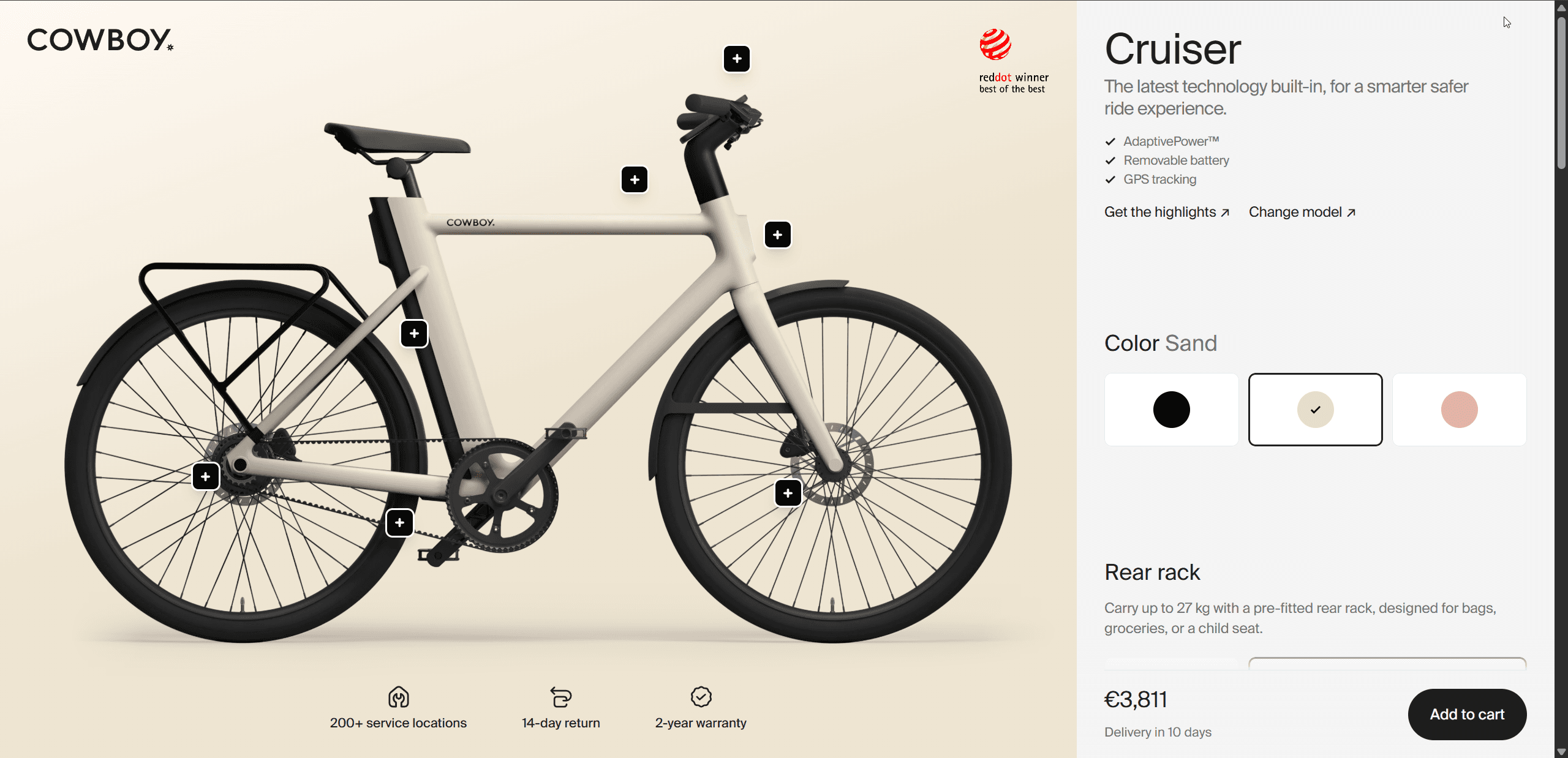
Cowboy Electric Bike 2D Configurator
 Cowboy
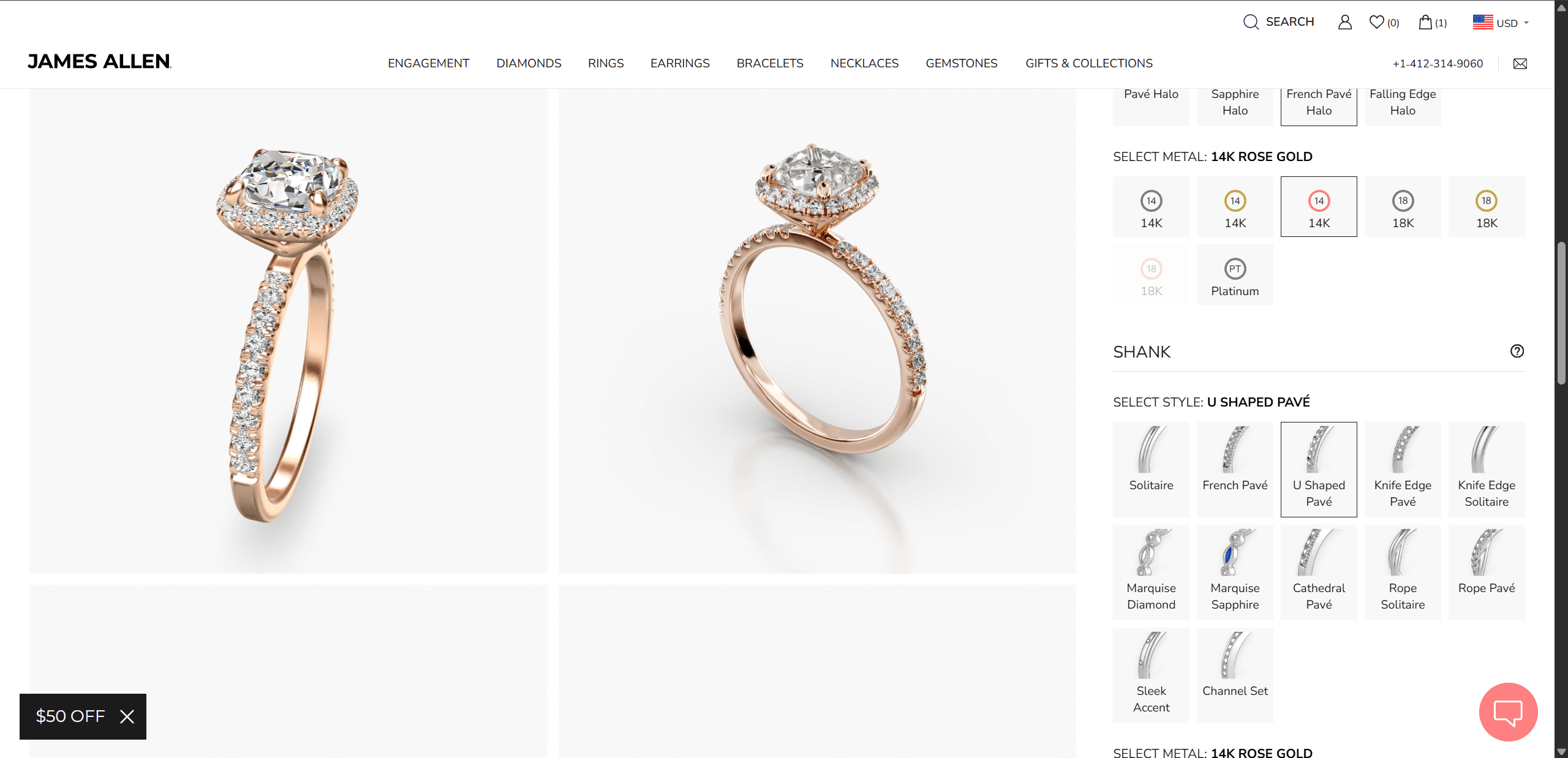
James Allen Diamond Ring Configurator
James Allen

Mute Workspace Cabins Simple 3D Configurator
Mute
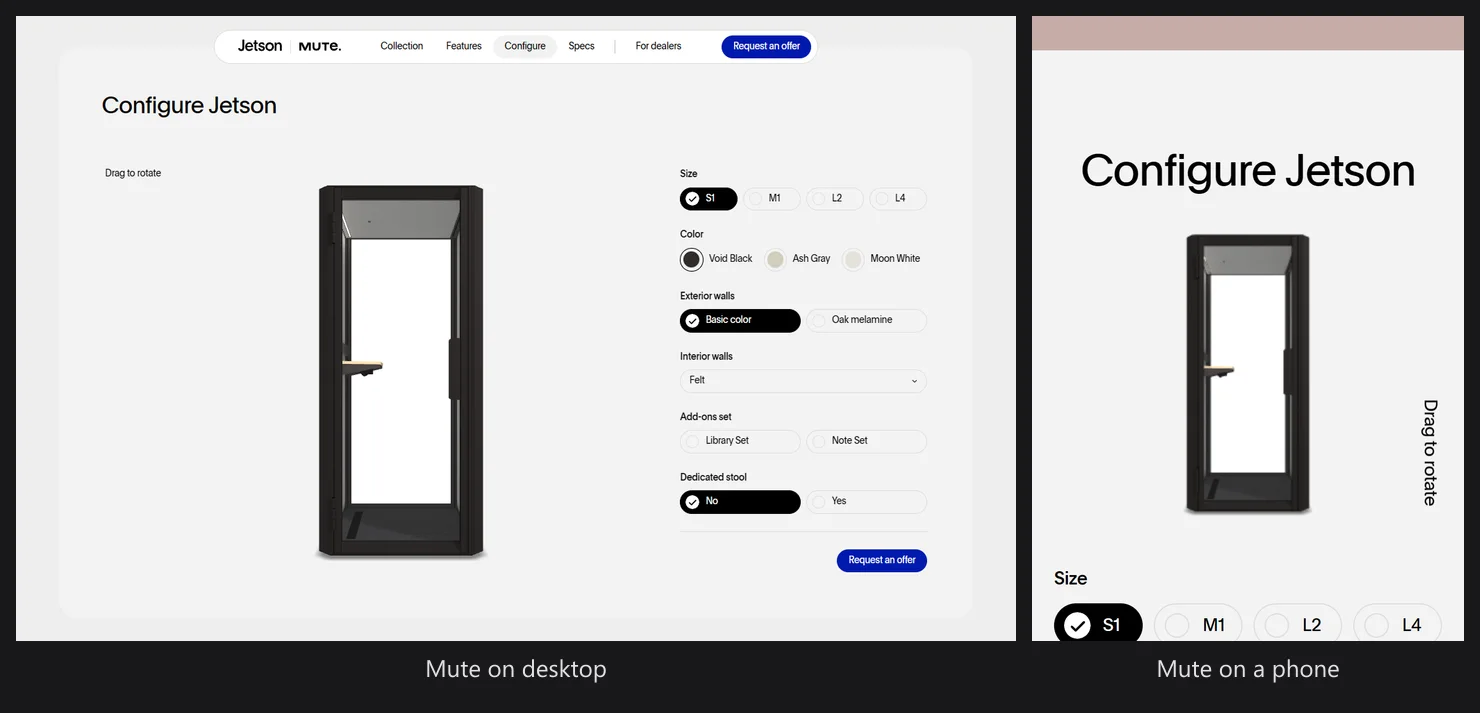
The mobile gap analysis covers the fixes in detail. If you already run a configurator, you can have it scored against the same rubric.
Frequently asked questions
Do we need a 3D configurator because a competitor has one?
Only if your product has choices that change how it looks, fits or costs. A Journal of Marketing study found AR lifts sales most for niche, pricier products and for shoppers new to the channel (Kellogg School of Management, 2022). With a handful of fixed SKUs, good photography and a simple 3D viewer may be enough.
Which industry has the best 3D product configurators?
No single industry wins on everything. At the time of writing, fashion and furniture lead our catalog on average performance at 4.16 and 4.10, while watches and jewelry lead on mobile at 3.98. For individual standouts, see our 3D product configurator examples.
Is real-time 3D better than 2D renders?
Not always. Real-time 3D powers 83% of the live listings we track, but 2D renders still win where photoreal materials matter more than free rotation, as Rolex and Ferrari show. Streamed 3D is the costly option, since BMW's EVE assigns one GPU to each user (AWS, 2026).
Can one configurator platform serve every industry?
The rendering engine can; the feature set usually can't. Three.js or Babylon.js will draw a sofa or a sneaker equally well, but measurement overlays, engraving, option rules and quote export are built on top. Measurement alone appears in 46% of furniture configurators, so check a vendor's live work in your industry's lead feature.
Find the leaders in your industry
The fastest way to brief a configurator is to open the top three in your own industry and write down what they do that you don't. Each industry page below lists its live configurators by score, highest first.
- Furniture and workspaces: 28 live listings
- Automotive: 25 live listings
- Fashion and accessories: 21 live listings
- Watches and jewelry: 21 live listings
- Home and garden: 20 live listings
Then hold the leaders against your industry's row in the heatmap. If every leader shows dimensions and your plan doesn't, you need a good reason, and if your plan copies a car configurator's camera work for a bookshelf, you probably need a different plan.
The same pages double as 3D website examples by industry, since they include product viewers and showrooms as well as configurators. The shares in this post recalculate as we add and rescore listings.